Posts tagged ‘salvation’

Why Would He Do That?

It is perhaps the best known verse in the New Testament, if not in the entire Bible. It is the most commonly memorized, the one most frequently on signs at football games. It is John 3:16. And it should be that way, for there despite its milky appearance, this verse is loaded with meaning and significance. So lets take it apart and see what we can find in there.

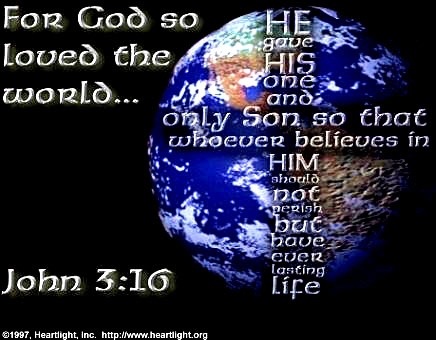
For God so loved the world that He gave His only begotten Son, that whoever believes in Him should not perish but have everlasting life. (John 3:16 NKJV)

“For God so loved”
First and foremost, this verse is not telling us about a ourselves. This verse gives us a look at the character of God. God is the initiator in this relationship. He was not responding to mankind’s collective plea for help, for at the time we were not just ignorant of God, we were His enemies. Romans 5:8 says that “God demonstrates His love for us in this”. As the apostle John later writes in his first letter, “In this is love, not that we loved God, but that He loved us and sent His Son to be the propitiation for our sins. (I John 4:10).

“…the world”
God did not pick out just a few elect persons to save. He did not come and make provision for the salvation of one man. No, Jesus was sent to “seek and save the lost”. To do that, a sacrifice was needed that was sufficient for everyone.

And He Himself is the propitiation for our sins, and not for ours only but also for the whole world. (I John 2:2)

“that He gave”
The God who is love personified, became a person to show us His love. Love does that. It gives. God wasn’t sitting up in heaven having feelings for us. He acted and demonstrated His love.

“His only begotten Son”
When infinite love gives, the gift is of infinite value. God did not create an angel and send him down to be our sacrifice. He is so in love with us that He gave that which is dearest of all to His heart — His Son. I have three sons, and I cannot imagine willingly sending one to be tortured and killed for my enemies. But the infinite love of God did just that.

“that whoever believes in Him”
While the gift is sufficiently valuable for all, it is only efficacious for those who accept it. It is just like when a doctor writes you a prescription so you can recover. You can leave the bottle on your nightstand for months and years, and it will do you no good whatsoever. You have to take it for it to work. In the same way, if we don’t believe in Him, we will not be saved. And thankfully the invitation is to “whoever” which is a group that includes each of us!

“should not perish but have everlasting life.”
We were all condemned to die. We were without God and dead in transgressions and sins. But Jesus came to give us life (John 10:10). We, who were His enemies, now will live with Him forever. The next verse, john3:17, says it this way.

For God did not send His Son into the world to condemn the world, but that the world through Him might be saved. (John 3:17)

We were already condemned. His mission was to save us. God loves us and did everything to provide us a way back to Himself. And that is what the Lords Supper is about.

As we look at the unleavened bread and the fruit of the vine, we are reminded not only of His broken body and His blood that was shed for our redemption. We also recall the love that motivated such a sacrifice for ones as undeserving as us. Yes, it is love that causes grace, that saved a wretch like you, and you, and me!
20121202-082229.jpg

A Salvation Experience

I remember the date, time, and place that I was born again. If I had a 1977 calendar, I could mark it down for all to see. That is because salvation is something that is experienced. We don’t get it by inheritance because our parents had it. God doesn’t have grandchildren. We have to have our own faith. No matter how much you admire someone, their salvation is just that — theirs.

Nor can you be saved and not know it. God does not regenerate you without your consent. We do not suddenly come to the realization that somehow, in some way, you have become a Christian. There is no surprise salvation. Yes, salvation is an intentional and individual experience.

But at the same time, what do some folks mean by “a salvation experience”? Is there some common emotional experience that every new believer has? Do we need a special tingle in our toes, or a quiver in our liver before we can be sure of our salvation? Are we required to “pray through” at a mourners bench to beg and plead for God to save us? No, not at all.

We need faith, and that comes by hearing the Word of God. It is available to anyone who hears that word and has a willing heart. That is something that we experience.
We need to repent, and that is a natural next step when someone believes the message of the Gospel. And it is a decision that is intentionally made, so it is also an experience.
That faith and repentance will manifest itself in obedience and a changed life. Those are all things that are experienced.

Where we need to tread with care is in taking the feelings, circumstances and emotions that we had when we were saved and conclude that if someone else did not have those same emotions and feelings then they are not saved. The Holy Spirit works through the Word in the same way toward everyone, but each of us is different so our reaction to that work will be different in every case. And that is okay. It is a sad sight to see someone who would stand up and say with great conviction that baptism is not required for salvation because it is a work, turn around and have someone pray and weep and beg and plead at a mourners bench for hours to be saved. I ask you, “how is that less of a work than baptism?” I know which one is a lot easier to do.

So lets take the Bible, see what it says is necessary for salvation, keep it simple by not adding to it, and let our individual “salvation experience” be as unique as each of us. We can only trust what the Word says about salvation, and not our emotions or an experience. Because if it does not line up with Scripture, then our emotions about an experience can leave us deceived and lost. Let’s obey Jesus instead of seeking a spiritual high, because the proof of salvation is the fruit of obedience it produces, not the feelings it stirs.

And having been made perfect, He [Jesus] became to all those who obey Him the source of eternal salvation, (Hebrews 5:9 NASB)

20121129-235459.jpg

Real Faith Works!

Ever since the days of the Reformation, there has been a strong emphasis on teaching that salvation is by faith. Given the unhealthy stress placed on works at the time, this was a normal reaction. What is needed is a healthy, and accurate, view of the relationship between faith and works if we are to be spiritually healthy and balanced. When James, the Lord’s brother, wrote his letter, the Spirit inspired him to address the subject this way:

Even so faith, if it has no works, is dead, being by itself. But someone may well say, “You have faith and I have works; show me your faith without the works, and I will show you my faith by my works.” You believe that God is one. You do well; the demons also believe, and shudder. But are you willing to recognize, you foolish fellow, that faith without works is useless? (James 2:17-20 NASB)

There is no contradiction here with the message the apostle Paul would later give to the church at Ephesus. Read carefully what Paul wrote:

For by grace you have been saved through faith; and that not of yourselves, it is the gift of God; not as a result of works, so that no one may boast. (Ephesians 2:8, 9)

He is saying, correctly, that our salvation does not come from our performance, or from working our way to God. No one can will ever be able to say that God owes them salvation. But also notice what Paul goes on to say in verse 10.

For we are His workmanship, created in Christ Jesus for good works, which God prepared beforehand so that we would walk in them. (Ephesians 2:10)

We were created in Christ when we are born again, for the uprise of good works. Do you see the order here? The works don’t cause faith and salvation; the faith and salvation produce the works! Furthermore, God has it planned that way.

God always connects a truth to believe with a command to obey. While “faith” and “obedience” can be defined as separate terms, they are inseparable as realities. To put it succinctly, real faith, works!
That being said, faith has to come first. We can have works without having faith (i.e. dead works), but we cannot have faith without works. Build your faith and the works will follow. It is a trap to suppose that we can reverse the polarity of our spiritual power by putting works as a higher priority than cultivating intimacy with God and strengthening our faith.

For we through the Spirit, by faith, are waiting for the hope of righteousness. For in Christ Jesus neither circumcision nor uncircumcision means anything, but faith working through love. (Galatians 5:5, 6)

20121114-235336.jpg

The Altar Principle

God likes altars. All through the Old Testament, altars are frequently mentioned as being something God commands for His people to build when there has been a spiritual victory. These altars serve as constant reminders, sometimes long after the original builders has passed on, of what God has done for His people. Noah, Abraham, Moses, Joshua, Samuel, and David all built altars as reminders of what God had done.

But does at carry over in any way to the New Covenant? Are we supposed to go outside and pile up some rocks and burn animals in sacrifice? No, in spite of what my barbecue may look like, burnt offerings are not for today. But I believe there is an “Altar Principle” in place that we would do well to remember. We already practice the Altar Principle when couples marry. The wedding rings serve as visual reminders of a spiritual covenant that was entered into, and in that way function as a kind of altar. The brides ring may even include a rock!

I’m not sure of the precise accuracy of these numbers but they are at least directionally correct. It has been said that students remember 25% of what they hear, 50% of what they hear and see, and 75% of what they hear, see, and participate in. This is especially true when repetition is added into the equation. I that way, the Lords Supper, or Communion Feast, exemplifies that principle. On a weekly basis we hear about what Jesus did, see the elements that represent the body and blood of Christ, and eat and drink together, the salvation message is reinforced in the hearts of believers. That is how the altar principle works.

When a married couple is being counseled, they can be told to look at their rings and remember the promises they once made to each other and to God. They serve as a point of reference for them and help them to focus on what is important. One huge danger sign is when either partner removes their wedding ring in public, so as not to be noticed. They are attempting to hide the sign of their covenant from sight so they will not be reminded that they are bound to another.

Baptism also has a altar principle attached to it. Paul would refer to the fact that believers had been baptized and remind them of what that meant.

What shall we say then? Are we to continue in sin so that grace may increase? May it never be! How shall we who died to sin still live in it? Or do you not know that all of us who have been baptized into Christ Jesus have been baptized into His death? Therefore we have been buried with Him through baptism into death, so that as Christ was raised from the dead through the glory of the Father, so we too might walk in newness of life. (Romans 6:1-4 NASB)

Paul is saying that when Christians are tempted to willfully sin, that baptism serves as a reminder that they have a new life in Christ and have been freed from sin, so with that in mind, how can we walk anymore in it? For that reason, we need to think back and remember our baptism and what it symbolized. We need to remember that we, too, have died, been buried, and risen with Christ.

I would recommend to anyone that they think back often of their conversion experience, and specifically their baptism. Use it as an altar, or a reference point in your life that you can point back to and remember what great things The Lord has done for you when He saved you from darkness and translated you into the Kingdom of the Son of His love.

20121110-001109.jpg

The Blood Cries Out

Murder is a terrible thing. That is especially true when it involves family members. When a murder happens, there is instinctively a desire for justice and punishment. There is a felt need for justice to be done and for retribution to be handed out. Such was the case when e first murder occurred in Genesis as Cain killed his brother Abel.

Now Cain talked with Abel his brother; and it came to pass, when they were in the field, that Cain rose up against Abel his brother and killed him. Then the Lord said to Cain, “Where is Abel your brother?” He said, “I do not know. Am I my brother’s keeper?” And He said, “What have you done? The voice of your brother’s blood cries out to Me from the ground. “So now you are cursed from the earth, which has opened its mouth to receive your brother’s blood from your hand. (Genesis 4:8-11 NKJV)

Because of his crime, the blood of Abel cried out from the ground and brought down upon Cain a curse for his crime.

There is another time in Scripture that there is blood that cries out. During what is commonly called the passion of Christ, his blood was also shed. During the beatings, the scourging, and the crucifixion, Jesus shed blood. Like Abel, it was blood that was being shed by an innocent man, and was in connection with the offering of a sacrifice. The Hebrew writer says this about that blood:

to Jesus the Mediator of the new covenant, and to the blood of sprinkling that speaks better things than that of Abel. (Hebrews 12:24 NKJV)

Abel’s blood, when it was shed, cried out to God for judgment, justice, and condemnation. The blood of Jesus also cries out, but speaks of better things. The blood of Jesus cried out “atonement, grace, forgiveness, and salvation!” The blood of Abel was like the sacrifices of the Law which only had the power to condemn. But the blood of Jesus is the blood of the New Covenant that brings forgiveness instead of guilt, grace instead of law, and salvation instead of condemnation!

In context, the Hebrew writer was making reference to an event that happened on Mount Sinai when Moses came down the mountain and found that the people were reveling in their sinful passions. On that day at Mount Sinai 3,000 people were killed as God judged them for their sins.
So the sons of Levi did according to the word of Moses. And about three thousand men of the people fell that day. (Exodus 32:28 NKJV)
Later, when the church was born at the feast of Pentecost, this time on Jerusalem (Mount Zion), the Holy Spirit descended, the Gospel was preached, and 3,000 people were saved. That is the difference now that the blood of Christ has been shed. Instead of instant judgment by the Law, those who received the Word and were baptized that day were forgiven and given eternal life! All of this was and is made possible by the blood of Christ that “speaks better things” for those who believe and obey the Gospel!

So come by the blood. Come to Christ and appropriate for yourself that cleansing power and have the blood cry out “forgiven, justified, and set free” over you today! Have peace with God because of the blood that was shed for your salvation.

and by Him to reconcile all things to Himself, by Him, whether things on earth or things in heaven, having made peace through the blood of His cross. (Colossians 1:20 NKJV)

20121107-231013.jpg

The Parable of the Operating Room

The Parable Of The Operating Room
I don’t know anybody that relishes the idea of surgery, especially major surgery. But when it is a matter of life and death, most will submit to it willingly because it still beats dying. Well I want to talk about another operating room. In fact, I call it “The Parable of the Operating Room”.

There was once a young man who, as far as he could tell, was leading a fairly normal and healthy life. Nothing seemed amiss, he wasn’t suffering from any maladies that he knew of, and he had every expectation for a long life. But at the insistence of a friend, he decided to have a physical examination anyway. If for no other reason than to be able to tell everyone around him that he was in perfect health.
At the doctor’s office, many tests were run, and everything was checked to make sure nothing was overlooked. The young man was not nervous at all while waiting for the test results, because he felt fine. To his surprise, the doctor entered the room with a very concerned look on his face. He was looking over the test results and slowly shaking his head.

Finally, the doctor looked up and broke the news to the young man. He said, “Young man, I hate to break this to you, but I am looking at these tests, and there are ten clear symptoms here that you are not only very ill, but are terminally ill.”
Starting to panic, the young man what these symptoms could possibly be. As the doctor ran down the list, the young man could only agree and wonder why he had never thought of the symptoms as a warning. The doctor said that everyone with these symptoms thinks they are normal untitled hey see the way the test results should have come out. Then it becomes painfully obvious that the condition is lethal.
“But, rest assured, young man,” the doctor said. “There is a cure that has been found and I can take care of this problem. All you need to do is submit to this operation and you will have a new life ahead of you. The procedure is very costly and you could never afford it, but I am willing to do it for free. Shall we proceed?”
Of course, now that the young man is aware of his true condition, he is more than willing to have the surgery. So the doctor has him admitted, has the young man wheeled into the operating room, and performs life saving surgery. All is well and the young man is eternally grateful for what the doctor has done. This is especially true since the doctor performed the surgery without charge.

So what is the meaning of my little parable? Glad you asked!
The young man is every one of us when we were without God. We were condemned by our sins, but had no idea that we were in any danger. All the while, we were in a spiritually terminal condition, doomed by the silent killer called sin. But at some point, often at the urging of a loved one, we are exposed to the Word of God. We looked into the Word and there, perhaps for the first time saw our true condition.

For the word of God is living and active and sharper than any two-edged sword, and piercing as far as the division of soul and spirit, of both joints and marrow, and able to judge the thoughts and intentions of the heart. And there is no creature hidden from His sight, but all things are open and laid bare to the eyes of Him with whom we have to do. (Hebrews 4:12, 13 NASB)

When the Holy Spirit, through the Word, convicted us of our sinful condition before God, we responded by gladly asking God to do whatever was required to cure our condition.
Please notice that the young man did not submit to this life altering surgery because the doctor had convinced him that, while he was okay, this procedure would make him even better and make his life easier. It was not until the young man was told of his true condition and its consequences that he gladly submitted the the master surgeon’s hands.
Jesus Christ is the doctor, and the tools of His surgery are grace, faith, and His own blood. Baptism is, if you will, the operating room. Now operating rooms never operated on anyone. Surgeons do that. And surgeons don’t use an operating room as the cure for anything. The scalpel and other tools do that, in conjunction with a supply of blood. But the operating room is where the surgery is supposed to take place! No surgeon, if given the choice, wants to operate on the hospital lawn. The proper place for surgery is in the operating room that was designed for that purpose. And when we try to omit the baptismal surgical suite, we are attempting an unnecessary shortcut that will endanger those we are trying to help.

Thus endeth the parable; thus endeth the lesson.

20121031-001040.jpg

Circumcision of the Heart

The Old Testament is replete with types and shadows that were fulfilled in Jesus Christ. One of those Old Testament symbols of the covenant was circumcision. Circumcision was so integral to the Old Covenant that the concept of an uncircumcised Jew was unheard of.

In Paul’s letter to the church at Colossae, he says that baptism is the spiritual fulfillment of circumcision.

In him also you were circumcised with a circumcision made without hands, by putting off the body of the flesh, by the circumcision of Christ, having been buried with him in baptism, in which you were also raised with him through faith in the powerful working of God, who raised him from the dead. (Colossians 2:11, 12 ESV)

Now that we are in the New Covenant with Christ, we experience a circumcision that is spiritual and of the heart. And according to Paul, this spiritual circumcision occurs at baptism. Fittingly, the concept of an unbaptized Christian is just as foreign to the New Testament as an uncircumcised Jew was to the Old Testament.

But is this verse in Colossians saying that baptism is what saves us? Well, was Abraham declared righteous before being circumcised or afterwards? According to Romans chapter 4, at what point was Abraham declared righteous?

“Blessed are those whose lawless deeds are forgiven,
and whose sins are covered;
blessed is the man against whom the Lord will not count his sin.”
Is this blessing then only for the circumcised, or also for the uncircumcised? We say that faith was counted to Abraham as righteousness. How then was it counted to him? Was it before or after he had been circumcised? It was not after, but before he was circumcised. (Romans 4:7-10 ESV)

It was Abraham’s faith that caused him to obey the commandment of God and be circumcised, and it would be accurate to say that if Abraham had refused to obey God that he did not have faith. His obedience proved his faith. In the same way, we are declared righteous when we have faith, and that faith is proven, or validated, by our submitting to baptism.

Thus, salvation is by faith, and that faith is shown by our baptism. Righteousness comes by faith, and is not of works. We are saved by faith, not by faith plus a ritual. But that sign of the covenant must not be diminished or disregarded, either. Just as faith without obedience is out of context, obedience without faith is useless as well. But the connection of the old circumcision to baptism is clear. And Abraham was declared righteous because he believed God before he was circumcised. In the same way, we are declared righteous when we believe, and we submit to the sign of our covenant relationship when we are baptized. Failure to do so proves we didn’t really believe in the first place.

20121019-003123.jpg

In the Glory Land Way

Navigation systems.
Seems like nowadays we have to have them. They are useful, when the work correctly. But many things can go wrong. Sometimes, if you put in that you want to go to Appleton, you have to make sure you specify the one in Wisconsin. Following directions to Appleton, Illinois will not get you home any time soon!

We are all on a journey, and we need to make sure we are on the correct path, and also in the right kind of vehicle if we are to arrive at our desired eternal destination.

The onramp: Salvation
Before we are delivered from sin, we are all on the wrong road. It is a very wide and spacious road, and no one gets in your way. Most folks are on it, and who are we to say that they are wrong? Right? Well Jesus said otherwise.

“Enter through the narrow gate; for the gate is wide and the way is broad that leads to destruction, and there are many who enter through it. For the gate is small and the way is narrow that leads to life, and there are few who find it. (Matthew 7:13, 14 NASB)

The vehicle: Grace
In Ephesians 2:8-9, Paul wrote that we are saved “by grace through faith” so I am making grace the vehicle, and faith the engine. For after we are saved, we must remain in grace in order to make it to our heavenly home. At no point in the journey are we ever without the need for grace. So now we have the vehicle, and discovered as well that it is ours as a gift! So how do we make it go?

The Engine: Faith
We must have faith to make any progress on our Christian journey. And faith we must have, without faith we cannot please God, nor receive the reward for those who diligently seek him.

And without faith it is impossible to please Him, for he who comes to God must believe that He is and that He is a rewarder of those who seek Him. (Hebrews 11:6 NASB)

But how do we get this faith and make it strong? By taking in the Word of God!

So faith comes by hearing, and hearing by the word of God. (Romans 10:17 WEB)

So we now know we need faith for an engine, and we know where to get it. Now we need some fuel.

The Fuel: Love
The fuel our faith engine runs on is love.

For in Christ Jesus neither circumcision amounts to anything, nor uncircumcision, but faith working through love. (Galatians 5:6 WEB)

For this reason I too, having heard of the faith in the Lord Jesus which exists among you and your love for all the saints, (Ephesians 1:15 NASB)

I cannot emphasize enough the importance of love. Without it, your entire journey is for nothing. Nothing else matters if you don’t mix it with love.

so that Christ may dwell in your hearts through faith; and that you, being rooted and grounded in love, (Ephesians 3:17 NASB)

We have our vehicle, the engine is in, the tank is fueled, and will continue to be refilled, with love. What kind of highway are we supposed to drive on?

The Road: Patience
Back in Matthew 7 we saw that the road is narrow and few people will find it. Once we are on this narrow road, what kind of road is it? It is a road of patience. If we were to receive everything instantly, we would have little opportunity to build our character. It is in the waiting that we learn to trust God.

so that you may not be sluggish, but imitators of those who through faith and patience inherit the promises. (Hebrews 6:12 ESV)

Yes, our final salvation must be hoped for with patience.

For in this hope we were saved. Now hope that is seen is not hope. For who hopes for what he sees? But if we hope for what we do not see, we wait for it with patience. (Romans 8:24, 25 ESV)

Paul commended the Thessalonians for their patience, faith and love.

Remembering without ceasing your work of faith, and labour of love, and patience of hope in our Lord Jesus Christ, in the sight of God and our Father; (1 Thessalonians 1:3 KJV)

Now we are equipped for the journey. We have to remember that not of the things I have mentioned above are optional. They all are essential and there are no substitutes for them. Take away any of them, and the others are ineffective and/or nullified. If this is not a journey you have begun, or if you realize that you thought the journey had begun but find yourself on the broad road, come to Jesus and begin the journey on the narrow road. Get in the Glory Land Way!

20121012-234936.jpg

Can You Be Sure?

I can’t stand that sinking feeling I have when I am going into a meeting unprepared. Can you imagine going into court to be judged and being unsure if you will be found innocent or guilty? Well the apostle John takes time in his first letter to reassure the persecuted disciples and to help them to be sure that they were in fact saved. Later on in chapter 5:13 John will state that we can know we have eternal life. At the end of chapter 2 he restates some things to emphasize his point.

And now, little children, abide in him, so that when he appears we may have confidence and not shrink from him in shame at his coming.
If you know that he is righteous, you may be sure that everyone who practices righteousness has been born of him. (1 John 2:28, 29 ESV)

John revisits the promise God has given us from verse 25, which is eternal life. Eternal life is not just life that does not end, but rather includes a quality of life that is only possible in the presence of God. So we are not just talking about existing forever. But how do we know that we have that life now, and will also inherit that life in the end? By whether we “practice righteousness” or not.

First of all, we need to know what this does NOT mean. It does not mean constant sinless perfection. If that we’re the case, we would be constantly slipping in and out of salvation as we sin and then confess. If this were the case, our entire eternity would be based on the timing of our death. And you had better hope you never committed a sin and didn’t realize it, especially if you have forgotten about it!

John also is not saying that by the performance of one righteous deed we are saved. We can no more earn heaven than long jump to the moon. The righteousness we have is as the result of appropriating what Jesus Christ has done for us, and not trusting in our own merit for salvation. In 2 Corinthians 5:21, Paul said:

He made Him who knew no sin to be sin on our behalf, so that we might become the righteousness of God in Him. (2 Corinthians 5:21 NASB)

Our righteousness is the result of being in Christ. But you cannot be “in Christ” and not have it change you. But even as fruit requires growth, often slow growth, we must realize that we are not going to instantly be sinless, but will need time to mature as we bear steadily increasing fruit.

We have to realize why it says “practices” here. John is talking about a lifestyle characterized by trying to do what is right. Are we following after Jesus, or are we following after the world? Ae we acting in faith, or have we decided to define good and evil for ourselves? So let us test ourselves to see if we are growing in righteousness. In 2 Corinthians, Paul puts it this way:

Test yourselves to see if you are in the faith; examine yourselves! Or do you not recognize this about yourselves, that Jesus Christ is in you-unless indeed you fail the test? (2 Corinthians 13:5 NASB)

When reading the Bible, ask God to open your eyes to areas that need fixing in your life, but also see where you are doing well and begin to increase in those areas. But know this — don’t stay there constantly wondering if you are saved. Be about the Lords work and be confident that when he does appear, He will say to you “well done”.

20121008-155332.jpg

Keeping It Simple

I like keeping things simple and easy to understand. There is a virtue in making sure we make things understandable for people, especially when it comes to salvation. We are not Gnostics with some special knowledge that is only for us. We have a life giving message that our Lord commissioned us to proclaim to everyone on earth. We don’t have time for a 1000 page dissertation on what it takes to become a Christian. So let’s break it down to three essential questions and answers we can give to someone who would ask us about what is required to be a Christian.

1. How much am I required to know?
You have to know something, but you don’t have to know everything. The Apostle Paul summarized it well in his letter to the church at Corinth.

“1 Now, brothers, I want to remind you of the gospel I preached to you, which you received and on which you have taken your stand. 2 By this gospel you are saved, if you hold firmly to the word I preached to you. Otherwise, you have believed in vain. 3 For what I received I passed on to you as of first importance: that Christ died for our sins according to the Scriptures, 4 that he was buried, that he was raised on the third day according to the Scriptures,”
(1 Corinthians 15:1-4)

You must believe that Christ died, was buried, and rose again. That is the Gospel message. But that leads to the next question,

2. What must I do about what I know?
You must participate in that death, burial, and resurrection, too. It’s called baptism. It sums up what you believe and shows that you have turned from your old way of life (called repentance). Again, Paul illustrates it for us, this time in Romans 6.

Or do you not know that all of us who have been baptized into Christ Jesus have been baptized into His death? Therefore we have been buried with Him through baptism into death, so that as Christ was raised from the dead through the glory of the Father, so we too might walk in newness of life. For if we have become united with Him in the likeness of His death, certainly we shall also be in the likeness of His resurrection, (Romans 6:3-5 NASB)

In effect, we are participating in what we know.

3. What happens after that?
We gather with other believers and remember that death, burial, and resurrection and encourage one another as we strive to follow Jesus.

Is not the cup of blessing which we bless a sharing in the blood of Christ? Is not the bread which we break a sharing in the body of Christ? (1 Corinthians 10:16 NASB)

This walk of faith is not designed to be done alone. We gather to remember what Christ has done and to be equipped to share that message with others.

I realize this is very basic, but we must all begin somewhere. If we focus our evangelistic message on the death, burial and resurrection of Jesus, we also make sure that the message is not about us — it’s about Jesus. We are not commanded to convert people to us; we are commanded to make disciples of Jesus.

Go therefore and make disciples of all the nations, baptizing them in the name of the Father and the Son and the Holy Spirit, teaching them to observe all that I commanded you; and lo, I am with you always, even to the end of the age.” (Matthew 28:19, 20 NASB)

There are our marching orders. He tells us to make disciples and also tells us how to do it. Let us go forth in the simplicity of devotion to Christ with the truth of Jesus’ death burial and resurrection as our message. Amen.

20120926-072250.jpg