Posts tagged ‘Jesus’

God Listens To Abba

Many children have terms of endearment for their parents and grandparents. While these names may not make sense to an outsider, to those inside the relationship those names evoke the fondest of memories. One such term that is used in the New Testament is “Abba” and it means “daddy”.

The term Abba conveys a sense of utter trust and intimacy between a child and a father. So much so that it is even carried on into adulthood. It was in the Garden as Jesus prayed on the night he was betrayed, “Abba! Father! All things are possible for You; remove this cup from Me; yet not what I will, but what You will.” (Mark 14:36 NASB) In His hour of deepest sorrow and emotional pain, Jesus cries out to the Father with the most intimate name he knows – Abba. While His Father is high and exalted above all the universe, He is also “Daddy”.

I read the story of a tourist in Israel years ago who was walking with his tour guide in a residential neighborhood. As the walked, they saw a man park his car in front of a house. Immediately two small children ran out the front door to welcome him home from work, crying out “Abba! Abba!” until he hugged and kissed them and carried them back into the house.

It is that same spirit that we have as Christians in our hearts, because God is now our Father and we are his children. Paul wrote about that relationship in letters to Rome and the churches in Galatia.

For you did not receive the spirit of slavery leading again to fear, but you received the Spirit of adoption, by whom we cry, “Abba, Father.” (Romans 8:15 NET)

And because you are sons, God sent the Spirit of his Son into our hearts, who calls “Abba! Father!” (Galatians 4:6 NET)

Think about that! We now have the privilege of using the intimate name that Jesus himself used when addressing is Father! And because of the love relationship we have with God, we can call Him Abba because we have been brought into the family as adopted children.

I think that is what the Hebrew writer had in mind when he said this:

Let us therefore come boldly to the throne of grace, that we may obtain mercy and find grace to help in time of need. (Hebrews 4:16 NKJV)

We don’t have the boldness of a trusted advisor or even a daily servant. We have the same boldness to enter into His presence as the King’s children have. It is not based on talent, experience, or status. We can come to our Abba Father at any time simply because He is our Daddy and we know how much He loves us!

The Apostle John summed it up best:

See what great love the Father has lavished on us, that we should be called children of God! And that is what we are! The reason the world does not know us is that it did not know him. Dear friends, now we are children of God, and what we will be has not yet been made known. But we know that when Christ appears, we shall be like him, for we shall see him as he is. (1 John 3:1, 2 NIV)

20120820-004026.jpg

Being Like Andrew

I like to do biographical studies in the Bible. It keeps things fresh and sometimes it helps when I get an overview of someone’s life instead of looking just at single instances. One person I find fascinating, even though little is said about him, is the Apostle Andrew.
Andrew was Peter’s brother, and actually became a disciple before him. While he is usually mentioned fourth in the lists of Apostles, it becomes apparent that his brother Peter was part of Jesus’ inner circle. Yet there is never any mention of envy or jealousy on Andrew’s part. Rather than let pride rule him and become resentful of Peter, he remains where Jesus has placed him, confident that God knows what is best.
Other than in lists, Andrew is only mentioned three times, all in the Gospel of John. And that is not surprising, since John and James were also fishermen and appear to have known Peter and Andrew. Let’s take a look at those three passages, and then draw some lessons from Andrew’s life.

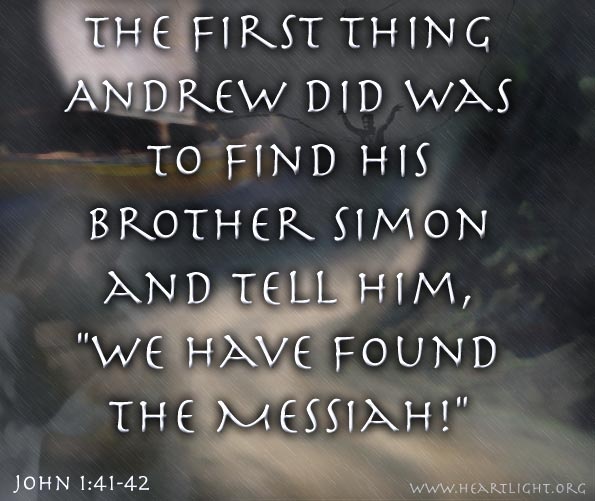
One of the two who heard John speak and followed Him, was Andrew, Simon Peter’s brother. He *found first his own brother Simon and *said to him, “We have found the Messiah” (which translated means Christ). He brought him to Jesus. Jesus looked at him and said, “You are Simon the son of John; you shall be called Cephas” (which is translated Peter). (John 1:40-42 NASB)

One of His disciples, Andrew, Simon Peter’s brother, *said to Him, “There is a lad here who has five barley loaves and two fish, but what are these for so many people?” (John 6:8, 9 NASB)

these then came to Philip, who was from Bethsaida of Galilee, and began to ask him, saying, “Sir, we wish to see Jesus.” Philip *came and *told Andrew; Andrew and Philip *came and *told Jesus. (John 12:21, 22 NASB)

So, what reason is there that these accounts are in Scripture? What do these stories have in common. After pondering and meditating on this for awhile, it became clear what they have in common.

Every time we see Andrew, he is bringing someone to Jesus!

First, he brings his brother, Peter. He is so excited about finding the Messiah, that he goes and gets the me closest to him and brings him to Jesus. How often all of us have seen someone newly converted, who in their zeal goes out and tells everyone they know about how wonderful our Savior is! As we mature in Christ, that wonder and enthusiasm needs to be stoked and kept hot.

Then he brings a little boy to Jesus at the feeding of the 5,000. There is nothing to indicate that he knew this boy. And yet the account doesn’t say Andrew grabbed him, took him kicking and screaming up to Jesus, and stole his lunch. Andrew had searched and found someone willing to bring all they had to the Master. We also should continue to seek out those who are inclined and willing to offer themselves to Christ and guide them to his feet.

And finally, a men came seeking after Jesus, who apparently knows who He is already. Andrew and Phillip simply assure them that Jesus is in fact there and do not hinder them. But these were not their kinsmen. The men were Greek proselytes who had come to the feast in Jerusalem. Yet there is no hesitation on Andrew or Phillips part. No sign of prejudice and thought that any man was less worthy to find Jesus. It is also worth pointing out that there was something about Andrew and Phillip that made it unnecessary for the men to ask them if they knew Jesus. He simply approached them and said, “sir, we wish to see Jesus. In our preaching and teaching, the only way we will be of any benefit to our hearers is for us to remember that what our audience really needs is to see Jesus. They don’t need to see our intellect or wit on display. They don’t need to be entertained. They just need to see Jesus!

We should all want to be remembered someday as an Andrew. Whenever people think of us, what a wonderful tribute it would be for them to say, “he was always bringing people to Jesus”.

20120819-010609.jpg

Turn Upside Down

Have you ever wondered why people in Australia don’t realize that they are upside down?

Seriously though, our society has been exposed and desensitized to upside down thinking that it is now perceived as “normal” instead of wrong. In Acts, Paul and Silas encountered a crowd at Thessalonica that was upside down in its thinking.

5 But the Jews who were not persuaded, becoming envious,took some of the evil men from the marketplace, and gathering a mob, set all the city in an uproar and attacked the house of Jason, and sought to bring them out to the people. 6 But when they did not find them, they dragged Jason and some brethren to the rulers of the city, crying out, “These who have turned the world upside down have come here too. 7 Jason has harbored them, and these are all acting contrary to the decrees of Caesar, saying there is another king—Jesus.” 8 And they troubled the crowd and the rulers of the city when they heard these things (Acts 17:5-8 NKJV)

They were accused of turning the world upside down because they advocated worship of a power higher than the human government. But in reality, the only way to keep human governments from becoming tyrannical is for there to be a higher power for them to answer to, and to have individual rights endowed by our Creator instead of the state. But the question that arises is this. Is there a point at which national pride becomes idolatry?

I submit to you that this happens when we substitute being salt and light for “my country, right or wrong.” When the first question out of our mouths is “is it legal” instead of “is it right” then we are on the slippery slope from being a nation whose God is the Lord to moral relativism and idolatry. We must not allow societal norms to dictate what is right and wrong.

God said it this way through the prophet Isaiah:

20 Woe to those who call evil good, and good evil;
Who put darkness for light, and light for darkness;
Who put bitter for sweet, and sweet for bitter!

21 Woe to those who are wise in their own eyes,
And prudent in their own sight!

22 Woe to men mighty at drinking wine,
Woe to men valiant for mixing intoxicating drink,
23 Who justify the wicked for a bribe,
And take away justice from the righteous man!

(Isaiah 5:20-23)

Does this sound like a description of our nation? If we cease to proclaim God’s standard of righteousness so that we won’t offend anyone, we betray our nation and their blood will be on our hands at the judgment! Are we any less idolatrous when we chant “USA, USA, USA” when our country is guilty of so many national sins that the Philippians in Acts 16 who were shouting for two hours “great is Artemis of the Ephesians”? It is okay to love your country, but it is not okay to make that country an object of worship. For those who shout “USA, USA, USA”; would you be as publicly vocal in shouting “Jesus is Lord”, “Christ is Risen” or “repent and obey the Gospel”?

While we are happy to support our society and our government when they do that which is right, we are obligated by our Master and Lord to withhold that support when those same institutions do what is evil in His sight!

13 “Enter by the narrow gate; for wide is the gate and broad is the way that leads to destruction, and there are many who go in by it. 14 Because[a] narrow is the gate and difficult is the way which leads to life, and there are few who find it. (Matthew 7:13)

We cannot follow the east road to destruction, but must follow the narrow way (the high way) to life. Love dictates that we also point others to that way as well. It’s time to get off of broad way and onto the highway! It’s time to shout “Hey USA, Jesus is Lord. Hey USA, Christ is Risen. Hey USA, repent and obey the Gospel!”

20120815-182649.jpg

Wanted: Dead & Alive!

Wanted: Dead & Alive!

No, that is what I meant to say. God is calling us to be in Christ, and to get there we have to be dead AND alive. What do I mean by that statement? Glad you asked. But what I would like to do is let the scriptures speak for themselves, with just a paragraph title.

We must be dead to sin and alive to righteousness.
“Or don’t you know that all of us who were baptized into Christ Jesus were baptized into his death? We were therefore buried with him through baptism into death in order that, just as Christ was raised from the dead through the glory of the Father, we too may live a new life. For if we have been united with him in a death like his, we will certainly also be united with him in a resurrection like his. For we know that our old self was crucified with him so that the body ruled by sin might be done away with, that we should no longer be slaves to sin— because anyone who has died has been set free from sin. Now if we died with Christ, we believe that we will also live with him.” (Romans 6:3-8 NIV)

For you died, and your life is now hidden with Christ in God. When Christ, who is your life, appears, then you also will appear with him in glory. Put to death, therefore, whatever belongs to your earthly nature: sexual immorality, impurity, lust, evil desires and greed, which is idolatry. (Colossians 3:3-5 NIV)

We must be dead to our will and alive to do His will.
“For through the law I died to the law so that I might live for God. I have been crucified with Christ and I no longer live, but Christ lives in me. The life I now live in the body, I live by faith in the Son of God, who loved me and gave himself for me. (Galatians 2:19, 20 NIV)

We must die to our old life and be born again to a new life.
Jesus replied, “Very truly I tell you, no one can see the kingdom of God unless they are born again.” “How can someone be born when they are old?” Nicodemus asked. “Surely they cannot enter a second time into their mother’s womb to be born!” Jesus answered, “Very truly I tell you, no one can enter the kingdom of God unless they are born of water and the Spirit. (John 3:3-5 NIV)

Therefore if anyone is in Christ, he is a new creature; the old things passed away; behold, new things have come. (2 Corinthians 5:17 NASB)

having been buried with Him in baptism, in which you were also raised up with Him through faith in the working of God, who raised Him from the dead. When you were dead in your transgressions and the uncircumcision of your flesh, He made you alive together with Him, having forgiven us all our transgressions, having canceled out the certificate of debt consisting of decrees against us, which was hostile to us; and He has taken it out of the way, having nailed it to the cross. (Colossians 2:12-14 NASB)

20120814-010602.jpg

Which Must Shortly Come To Pass

It is with much humility that we approach the book of Revelation. There are a multitude of reasons not to take many dogmatic positions here, not the least of which is that I want to reserve the right to modify or change my conclusions later on! And of course, Acts 17:11 always applies, so do your own research, too!
With that being said, I do believe that there is an erroneous teaching concerning the implications of Revelation 1:1 and the word “shortly” as it regards the timeframe for the events to follow in the next 22 chapters. What is being asserted is that, since it deals with things that must “shortly take place” then everything in that follows, with the possible exception of chapters 21 & 22 where it describes the church’s final state in Heaven, was to happen in the lifetime of the original recipients. This would, according to such expositors, mean that everything has already taken place. I have some problems with that.
First problem: the Greek word for shortly is “ἐν τάχει” which also can mean quickly. That would imply that when the things in this book start to happen, they will happen swiftly. That is the direction I lean because Jesus, the author of the book, neatly uses this same word in chapter 22, where in context everything is wrapped up and we are in the eternal state.
And he said unto me, These words are faithful and true: and the Lord, the God of the spirits of the prophets, sent his angels to show unto his servants the things which must shortly come to pass…
And he saith unto me, Seal not up the words of the prophecy of this book; for the time is at hand…
Behold, I come quickly; and my reward is with me, to render to each man according as his work is. (Revelation 22:6, 10, 12 ASV)

While many of the events of the first three chapters certainly did happen in the first or early second centuries, the fact that John is given this same word to use when describing a state which is still in the future for the saved means we can’t use verse 1:1 to categorically say that everything in the book was fulfilled in that time period. It just means that events will transpire rapidly when they finally do happen.

What is implied for us is that when these events happen, it will be too late to get ready for them. So no matter what your view of End Times prophecy, one question needs to be answered NOW — are you ready? Is your soul prepared for the return of the Lord? Or have you put it off and are walking dangerously unprepared to meet your God? Now is the time to prepare for eternity, for you know not when you shall enter it. Do not delay! Now is the day of salvation! Listen to the Gospel message, believe it, repent of your sins, confess that Jesus is the Son of God who died for you and was resurrected, and appropriate that saving work in the waters of baptism. Behold, do it quickly!

20120811-075033.jpg

The Crucible of Grief

“Why?”
It’s a question that leaps to the forefront of our thinking when we are confronted with a situation of pain and anguish. Especially when that situation involves the loss of a child. It’s difficult enough to bury your parents, but in the back of our minds we always knew we would someday. But it is totally unnatural to bury a child. There is a level of pain involved that never completely leaves us during this lifetime. We learn to cope and work through the pain, but the empty spot in our souls remains.
The songwriter Dana put it this way in a song about how Mary felt watching Jesus’ death:
I rocked him as a baby
I fed him as a child
I heard him call my name out in the night
I helped him take his first step
I cried when I heard his first words
I wish they all could see through a Mother’s eyes

There is no pain as acutely intense as that what a parent feels at the loss of their child. But our Heavenly Father knows how we feel at such a time, because he watched as his Son was illegally tried, falsely accused, and brutally murdered.

But we must never, not even for a little bit, think that the presence of pain is the absence of God. Jesus went to Bethany to comfort Martha and Mary after the death of their brother Lazarus. He came and wept with them, even though he knew he was going to resurrect Lazarus!
In Romans, Paul instructed Christians this way:
Rejoice with those who rejoice, and weep with those who weep. (Romans 12:15 NASB)

When ministering to someone who has lost a loved one, especially a child, there is nothing you can do or say that will make it all better. The Holy Spirit is the Comforter, and will accomplish His mission. But sometimes it is very comforting to have someone who is there to weep with you, like Paul said to do. That is even more meaningful if you have been through a similar loss in your past.

Blessed be the God and Father of our Lord Jesus Christ, the Father of mercies and God of all comfort, who comforts us in all our affliction so that we will be able to comfort those who are in any affliction with the comfort with which we ourselves are comforted by God. (2 Corinthians 1:3, 4 NASB)

If you have suffered a loss in the past, don’t keep the comfort that was given to you all to yourself. Pass it on to another one who is suffering. Make sure they know that they are not alone. Just “be there” for them and take care of details so they can focus on the grieving process.

The sun will shine again, and life will go on. Know that you are not alone for you have brothers and sisters in Christ, and most of all, you are under the care of the Comforter. And when you feel like you have hit bottom, you are resting upon God!
“The eternal God is a dwelling place,
And underneath are the everlasting arms”
(Deuteronomy 33:27a NASB)

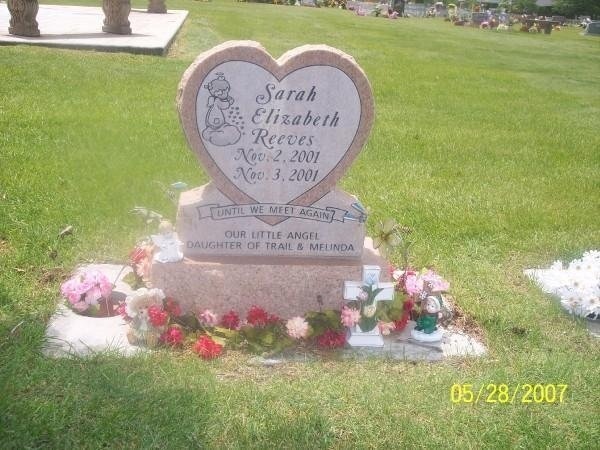
In memory of Sarah Elizabeth Reeves

20120809-001407.jpg

Getting Stoned?

How do you feel about your personal sins. Are some of them not too bad? Are there some we have given up on trying to totally weed out of our lives, and have just learned to keep secret? Are there some that, if anyone else knew about them, we would die of shame? Or are you rooting every sin in your life and gaining victory over it?

In the Gospel According to John, there is the familiar account of the woman caught in adultery. Unfortunately, it is too familiar to us and we are tempted to skim over it, sure that we have gleaned all that we could out of it. But take another look and see if there may be more there for us today.

Now early in the morning He came again into the temple, and all the people came to Him; and He sat down and taught them. Then the scribes and Pharisees brought to Him a woman caught in adultery. And when they had set her in the midst, they said to Him, Teacher, this woman was caught in adultery, in the very act. Now Moses, in the law, commanded us that such should be stoned. But what do You say? This they said, testing Him, that they might have something of which to accuse Him. But Jesus stooped down and wrote on the ground with His finger, as though He did not hear. So when they continued asking Him, He raised Himself up and said to them, He who is without sin among you, let him throw a stone at her first. And again He stooped down and wrote on the ground. Then those who heard it, being convicted by their conscience, went out one by one, beginning with the oldest even to the last. And Jesus was left alone, and the woman standing in the midst. When Jesus had raised Himself up and saw no one but the woman, He said to her, Woman, where are those accusers of yours? Has no one condemned you? She said, No one, Lord. And Jesus said to her, Neither do I condemn you; go and sin no more. (John 8:2-11 NKJV)

There are two sets of people addressed by Jesus here. The first are the scribes and Pharisees. The interrupt Jesus while he is teaching and cast her down on front of him. One wonders how a woman can be in the act of adultery and yet be alone. Ever wonder where the man who was also guilty? And how were they able, as religious leaders, to catch them in the act? I am just speculating, but I think the man was one of the scribes or Pharisees and they were covering this up for him. By trying to get Jesus to condemn her, they could kill the only witness and trap Jesus at the same time. In their eyes, it was a win-win proposition.

Jesus ignores them because he knows that she is already condemned, but that he would soon pay for her sin while shedding his blood on the cross. But rather than get into an intellectual debate with the religious scholars, he goes around there intellect and heads straight for their consciences. He forces them to reflect on their own sinfullness instead of that of the woman. And that is the initial reaction we should have as well when we hear about the sins of another. We have to remember that we, too, have sinned and deserve to condemned. The weight of their guilt becomes too heavy, and they can no longer hold their stones, and file away by age group — those with a lifetime of sin, followed by those just getting started.

The other me who is addressed is the woman caught in adultery and asks where her accusers are. That is just what he does when our sins are remitted at baptism. Satan, whose very name means “slanderer and accuser” has nothing with which to rail against us, for the blood of Christ has cleansed us from all sin. And based on the penalty that he would soon pay for her, he lets her leave. But he doesn’t just leave it at that. Unlike the religious leaders, she was already aware of her sinful state. Jesus tells her to go and sin no more. Implied in the original Greek is that he means to go and not do this sin any more. In effect, he tells her to repent. Forgiveness is not just a “get out of jail free” card. Change is expected. Not in order to be forgiven, but because we have been forgiven. That’s why he says it last, so she won’t think that her forgiveness must be earned.

We also, according to 1 John 1:9, can walk in a continually cleansed relationship with God. But that is not so that we can sin without consequence (see Romans 6), but so that we can start a fresh walk of obedience without condemnation from our past hanging over us.

So about those sins we spoke of at the beginning. Let’s get them taken care of at the feet of our Savior and go on with God!

20120808-011959.jpg

A Direct Cooperation With The Spirit

A very common teaching today is that no one can come to God without being acted upon by the Holy Spirit. It is taught that this action of the Spirit happens independent of human cooperation, and causes the sinner to be able to understand spiritual things and seek after God. Where do such doctrines come from? Let’s look at a few verses that seem to support this position.

No one can come to Me unless the Father who sent Me draws him; and I will raise him up on the last day. It is written in the prophets, ‘AND THEY SHALL ALL BE TAUGHT OF GOD.’ Everyone who has heard and learned from the Father, comes to Me. (John 6:44, 45 NASB)

But a natural man does not accept the things of the Spirit of God, for they are foolishness to him; and he cannot understand them, because they are spiritually appraised. But he who is spiritual appraises all things, yet he himself is appraised by no one. For WHO HAS KNOWN THE MIND OF THE LORD, THAT HE WILL INSTRUCT HIM? But we have the mind of Christ. (1 Corinthians 2:14-16 NASB)

If we just consider those passages, then the direct action teaching seems pretty solidly rooted in Scripture. But the problem is this; those are not the only verses on the subject, and we need to consider everything that has been revealed in the Word before coming to a conclusion.

If we agree that faith is required to please God, then we need to determine how faith is obtained. Paul said in Romans 10,

How then will they call on Him in whom they have not believed? How will they believe in Him whom they have not heard? And how will they hear without a preacher? How will they preach unless they are sent? Just as it is written, “HOW BEAUTIFUL ARE THE FEET OF THOSE WHO BRING GOOD NEWS OF GOOD THINGS!” However, they did not all heed the good news; for Isaiah says, “LORD, WHO HAS BELIEVED OUR REPORT?” So faith comes from hearing, and hearing by the word of Christ. (Romans 10:14-17 NASB)

Notice that the verse does not say that faith comes by election, but by hearing the Word of Christ. Paul confirms this when addressing the Galatians.

“This is the only thing I want to find out from you: did you receive the Spirit by the works of the Law, or by hearing with faith?” (Galatians 3:2 NASB)

From these two verses we can see that faith comes when a sinner hears the Word of Christ. This is also true because the Word of God is not a dead letter. It has inherent spiritual power within it.

“For the word of God is living and active and sharper than any two-edged sword, and piercing as far as the division of soul and spirit, of both joints and marrow, and able to judge the thoughts and intentions of the heart.” (Hebrews 4:12 NASB)

The Word of God, empowered by the Spirit in cooperation with faith growing in those who receive it, has the power to draw men to Christ and renew the mind. This is not limited to the salvation experience. This faith building and renewing of our minds is a lifelong journey of growth in the things of God.

So it is not a sovereign Divine act that enables sinners to come to God. It is, rather, a Divine cooperation with the Spirit that results in salvation.

20120807-004246.jpg

What God Owes Us

“Life isn’t fair!”

How many times have we heard children and others say those words, or had thoughts like that ourselves? When we say such things, what we are in fact saying is that if we were in charge, instead of God, things would be different. What that shows is a lack of faith and trust in God, and we are accusing God of making a mistake. Is that what you want to do?

In Romans 10 – 11, Paul is talking about the Jews being broken off due to disobedience and Gentiles being grafted in. At the end of his dissertation, Paul seems to burst into praise for God.

Oh the depth of the riches both of the wisdom and the knowledge of God! How unsearchable are his judgments, and his ways past tracing out!
“For who has known the mind of the Lord?
Or who has been his counselor?”
“Or who has first given to him,
and it will be repaid to him again?”
For of him, and through him, and to him, are all things. To him be the glory for ever! Amen. (Romans 11:33-36 WEB)

Rather than a random statement of praise, this is a deliberate declaration of the sovereignty of God, as if he is anticipating that some will question the wisdom of God’s dealings with Israel.
Paul begins with a foundational statement in verse 33. He is saying that, the knowledge and the wisdom of God is deeper and fuller than we have the capacity to comprehend. How ways, which are based on this complete knowledge and wisdom are so complex that there is no way anyone could understand why he does what he does. So don’t waste time in pursuit of a complete answer to why God does what he does.

In the next verses, Paul very frankly explains why God does not owe us an explanation for anything. This is because:
1. None of us can completely know Gods thoughts, so we are in no position to presume to give God advice on what he should do and how he should do it.

“For My thoughts are not your thoughts,
Nor are your ways My ways,” declares the LORD. “For as the heavens are higher than the earth,
So are My ways higher than your ways
And My thoughts than your thoughts. (Isaiah 55:8, 9 NASB)

2. God is not indebted to anyone. Whatever any of us has given to God originated from Him. We are only returning what God has provided. Jehovah God does not owe us anything, including an explanation.

3. It’s not about us; it’s about God! The purpose of our lives is to bring glory to God. God loves us and gives us all things to enjoy, but every one of those things are a gift, or grace, from God. Whatever we have in life that is good and pure is from God because he loves us. And we will give him glory for eternity for his indescribable gift! (2 Corinthians 9:15)

20120804-235357.jpg

Our Pains and Diseases

Healing is a popular subject these days. From medical advances that boggle the mind, to seeking out alternative cures and dietary solutions, it seems there is a universal desire to be healed. Better yet, we want to walk in health so we won’t need to be healed! It is no different in the religious world. A quick survey of religious broadcasting reveals numerous teachers preaching to packed arenas about divine healing. Prominent among such teaching is the idea that Jesus did not just pay for our spiritual healing on the cross, but that his suffering, specifically his stripes, paid for our physical healing as well. “Our healing has already been accomplished” they say. All we have to do is to have faith and not doubt, and receive the healing that is rightfully ours. But is this accurate teaching? Let’s see what the Bible says.

In the faith healing teaching, Isaiah 53 is a foundational passage. Let’s take a look at it and see if it is being properly applied or not.

But he lifted up our illnesses, he carried our pain;
even though we thought he was being punished,
attacked by God, and afflicted for something he had done.
He was wounded because of our rebellious deeds, crushed because of our sins;
he endured punishment that made us well; because of his wounds we have been healed. (Isaiah 53:4, 5 NET)

On the face of it, there seem to be two very compelling statements here about healing. In verse 4, The Suffering Servant (Jesus) is said to have lifted up our illnesses and carried our pain. And if one goes with the assumption that this verse is talking exclusively about the crucifixion, it looks like a reasonable interpretation of the verse. Fortunately, this verse is quoted in the Gospel of Matthew, chapter 8 verses 16-17, so we don’t have to guess at when this verse was fulfilled. Matthew records the following incident.

“When evening came, they brought to Him many who were demon-possessed; and He cast out the spirits with a word, and healed all who were ill. This was to fulfill what was spoken through Isaiah the prophet: “HE HIMSELF TOOK OUR INFIRMITIES AND CARRIED AWAY OUR DISEASES.” (Matthew 8:16, 17 NASB)

As anyone can see, this verse is not applied to all disease for all time being paid for at the cross. Through inspiration, the Apostle Matthew says that the miraculous ability Jesus had to heal the sick and drive out demons from those who were possessed was a sign that he was the Suffering Servant who would be our Messiah. In other words, they could recognize who Jesus was by his ability to heal the sick!

But what about Isaiah’s statement that by his wounds we have been healed? It is true that this portion of the verse could still be talking about our healing being paid for on the cross. True, that is, unless the New Testament apostles applied it to something else instead. Let’s see how this verse is applied by the Apostle Peter.

“When he was reviled, he did not revile in return; when he suffered, he did not threaten, but continued entrusting himself to him who judges justly. He himself bore our sins in his body on the tree, that we might die to sin and live to righteousness. By his wounds you have been healed. For you were straying like sheep, but have now returned to the Shepherd and Overseer of your souls.” (1 Peter 2:23-25 ESV)

At first this passage looks more promising because Peter is talking about what happened at the crucifixion of Jesus here. But again, how is the quote from Isaiah applied? To the bearing of our sins in his body on the cross, which would enable us to die to sin and live to righteousness (kind of sounds like baptism here). The result of this healing from the wounds he endured was verse 25. We are no longer like sheep who were astray, but have returned to God. His wounds purchased for us, not physical healing, but spiritual healing of our souls and our reconciliation to God! Once again, after careful examination, we find that the faith healers have misapplied this verse.

So can God heal today? According to Psalm 103, all healing of any kind is a gift from God. And surely God would not command us to pray for one another when we are sick if there were no benefit from it, or if said healing was not his will. In fact, during his earthly ministry, there is no record of Jesus ever declining to heal anyone who asked. But that was during his earthly ministry, and during the time of the apostles, who confirmed the validity of their message as being from God by signs and wonders (Hebrews 2:4) And one day, those of us who will spend eternity in his glorious presence will be freed from every disease and pain.
Until that time, enough of television and radio preachers who tell the sick that their healing is now, and they just have to receive it by faith. And if they are not healed, it is because they lacked that faith. To heap such guilt and condemnation on one who is suffering is beyond cruel, and only adds a deeper layer of suffering to the physical pain they are enduring. This is especially true of those who, like Simon the Sorcerer in Acts 8, tell desperate people that God is holding their healing but will pour it out upon them if they send in money.

No, the ultimate healing will take place in the dwelling place of God, not on this fallen earth.

“And I heard a loud voice from the throne saying, “Behold, the dwelling place of God is with man. He will dwell with them, and they will be his people, and God himself will be with them as their God. He will wipe away every tear from their eyes, and death shall be no more, neither shall there be mourning, nor crying, nor pain anymore, for the former things have passed away.” (Revelation 21:3, 4 ESV)

He who testifies to these things says, “Surely I am coming soon.” Amen. Come, Lord Jesus! (Revelation 22:20 ESV)

20120803-000620.jpg