Posts tagged ‘Jesus’

At All Times!

Wouldn’t it be great to always know the right thing to do in any situation you encounter? To know that, no matter what else you do, that there is something that brings God on the scene for our good? Well there is just such a thing you can do. In fact, it’s never the wrong answer! Let’s let the Apostle Paul show us what it is.

With all prayer and petition pray at all times in the Spirit, and with this in view, be on the alert with all perseverance and petition for all the saints, (Ephesians 6:18 NASB)

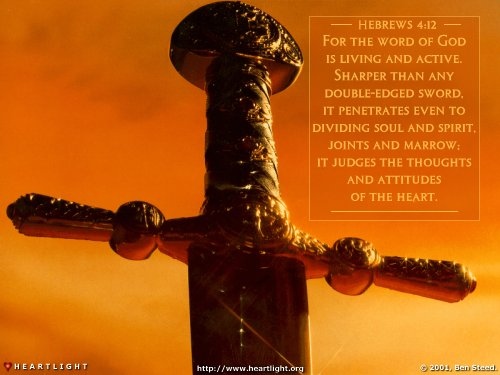
Both “pray” and “be on the alert” are participles in the Greek text. That means they are instrumental and connected with all the proceeding instructions. As such, they are not additional commands to do, but instead are the means through which the previous instructions are carried out. Without alert prayer, none of the things in the previous verses are possible! So if we are reading the prior verses about the armor of God and using the sword of the Spirit and asking ourselves how we are supposed to do all of this in a practical sense, then here is our answer in verse 18; pray and be alert. So when, in the present context, Paul says to pray in the Spirit, he is talking about how to wield the sword of the Spirit, the Word of God. There is something powerful about praying over the Word as we are reading and studying, and about using the Word of God in our prayers themselves!

We can also see that the word “all” is used four times in this verse.

ALL kinds of prayers and supplications are to be used: public prayers, private prayers, silent prayers, spoken prayers, long prayers, short prayers, intercessory prayers, prayers of thanksgiving, prayers of intercession, and every other kind!

ALL seasons are the season of prayer: all times of the day, all conditions and circumstances, all occasions, all states of mind, etc. There is no time that it’s the wrong time to pray!

ALL perseverance: through times of discouragement or defeat when it seems that all is lost, when victory has smiled or when it has failed …. let nothing hinder the prayer life.

ALL the saints are to be remembered in prayer. What an intercessor was Paul. His letters abound with the word that he is praying for those whom he remembers and for those who will receive his letters. He considered it his spiritual obligation to continue in constant prayer for his brothers and sisters in Christ. It is hypocritical in many ways to ask others to pray for us if we are not willing to also be in prayer for them as well.

Even though the Christian has put on the whole armor of God, he cannot win the victory except through a constant reliance upon prayer. A prayerless Christian is a contradiction of terms. When attacking an enemy, one of the first things that is taken out is the communications network. If you can cut off communication with their commanders, you render an army powerless to know how to fight. Satan has the same tactic. He wants us to cease communicating with the captain of our faith so that we become confused and powerless to recognize his tactics and resist him.

Prayer is not glamorous. Prayer is something largely done in private. But prayer is the tool that God has chosen to use to accomplish his will on the earth. Do you want to see God active in every one of your life situations? Then never think for a moment, in any circumstance, that “all we can do is pray” because prayer is the best, most powerful thing you could be doing!

Prayer — Just do it!

20120725-233830.jpg

A Pollution Problem

Have you ever met someone who, just by being there, makes things better? Someone who can touch a mess and make it look like art? On the other hand, have you ever known someone who can take anything, even the best things, and turn them into something twisted and filthy? What is the difference between the two?
In Titus 1:15, the Apostle Paul makes the following statement:
“To the pure, all things are pure; but to those who are defiled and unbelieving, nothing is pure, but both their mind and their conscience are defiled.” (Titus 1:15 NASB)
What does that mean for us?
It does no eternal good to reform a man on the outside without the new birth taking place and purifying him on the inside. Let me illustrate it this way.
A first century church is having a meeting, when in walks a leper. Not just any leper, but one with advanced disease whose rotting sores and dying flesh hang foul and putrid beneath the filthy rags he is wearing. Instantly, the folks there take pity on him, throw away his noxious shreds of clothing, and out him into a beautiful new white robe and new sandals on his feet. What is the lasting effect? Quickly the rottenness of his flesh begins to defile his clothing once again, and the leper is left in the same condition as before.
No matter what they did to clean up the outside, unless they cure the leprosy on the inside they are only taking what is clean and defiling it.
Such is the case with those who are trying to “be a good person” but who have not been born again. No matter how many charitable works they do, or what a good neighbor they are, their righteousness is as “filthy rags” (Isaiah 64:6) in the site of God because they have not been cleansed of their sins. The problem is not that they are as evil as they could possibly be. But since everything that is not done to the glory of God and in faith is a sin, every work they do, no matter what it is, is a sin!

But those who have been purged from their sins are pure. “To him who loves us and has freed us from our sins by his blood” (Revelation 1:5b ESV) And they remain pure as they confess (i.e. agree with God about) their sins and are thus continually cleansed (1 John 1:9).
It is when we are saved that our sins are remitted (Acts 2:38) and we are clothed with Christ for “as many of you as were baptized into Christ have put on Christ.” (Galatians 3:27 ESV) Only then can we be pure and do righteous works that are produced by our faith. Only then can we be said to have escaped the pollution that is in the world as our mind and conscience are renewed in Christ. “Do not be conformed to this world, but be transformed by the renewal of your mind, that by testing you may discern what is the will of God, what is good and acceptable and perfect.” (Romans 12:2 ESV)

20120723-002716.jpg

What About The Sabbath?

There are some today who teach that keeping the Seventh-day Sabbath is binding upon Christians today. Are they correct? Should we be worshipping God on the seventh day instead of the first day of the week? Let’s see what the Bible teaches.
Let’s start at the beginning, in Genesis chapter 2.
“By the seventh day God completed His work which He had done, and He rested on the seventh day from all His work which He had done. Then God blessed the seventh day and sanctified it, because in it He rested from all His work which God had created and made.” (Genesis 2:2, 3 NASB)
There is nothing, however, in the biblical record, that says that Jehovah directed Adam to keep the Sabbath himself. In fact, in Deuteronomy 5:15, Israel is told that the Sabbath was given, not to commemorate creation, but their deliverance from Egypt!
“You shall remember that you were a slave in the land of Egypt, and the LORD your God brought you out of there by a mighty hand and by an outstretched arm; therefore the LORD your God commanded you to observe the sabbath day.” (Deuteronomy 5:15 NASB)

In spite of this, many will argue that the Mosaic Law was divided into “moral” and “ceremonial” sections, and that only the ceremonial law was done away. The contents is that the moral law, or Ten Commandments, are still in force and binding on us today. Let’s see if Jesus considered them separate or not in Matthew 5:21-38.
Verse 21: “You have heard that the ancients were told, ‘YOU SHALL NOT COMMIT MURDER’ and ‘Whoever commits murder shall be liable to the court.’ (Part of the Ten Commandments)
Verse 23: Therefore if you are presenting your offering at the altar, and there remember that your brother has something against you, (Not part of the Ten Commandments)
Verse 27: “You have heard that it was said, ‘YOU SHALL NOT COMMIT ADULTERY’; (Part of the Ten Commandments)
Verse 31: “It was said, ‘WHOEVER SENDS HIS WIFE AWAY, LET HIM GIVE HER A CERTIFICATE OF DIVORCE’; (Not part of the Ten Commandments)
Verse 38: “You have heard that it was said, ‘AN EYE FOR AN EYE, AND A TOOTH FOR A TOOTH.’ (Not part of the Ten Commandments)
You see, Jesus mixed the two types of law freely, because in verse 17 he had stated that he came to fulfill the Law, not just a part of it.

So, if the Law is in one piece and not divided, are Christians bound to keep the Ten Commandments? What does Romans 7:6-7 say?
“But now we have been released from the Law, having died to that by which we were bound, so that we serve in newness of the Spirit and not in oldness of the letter. What shall we say then? Is the Law sin? May it never be! On the contrary, I would not have come to know sin except through the Law; for I would not have known about coveting if the Law had not said, “YOU SHALL NOT COVET.” (Romans 7:6, 7 NASB)

Not only does it say that we are released from the Law, but it cites the Tenth Commandment as being part of that Law! And Paul, in 2 Corinthians 3:7-11 writes this:
“But if the ministry of death, written and engraved on stones, was glorious, so that the children of Israel could not look steadily at the face of Moses because of the glory of his countenance, which glory was passing away, how will the ministry of the Spirit not be more glorious? For if the ministry of condemnation had glory, the ministry of righteousness exceeds much more in glory. For even what was made glorious had no glory in this respect, because of the glory that excels. For if what is passing away was glorious, what remains is much more glorious.” (2 Corinthians 3:7-11 NKJV)
Did you catch that? He directly speaks of that which was written in stone (i.e. the Ten Commandments) as that which was “passing away”!

So, since Jesus came to fulfill the Law, how did He fulfill the Sabbath? Hebrews 4:4-11 puts it this way:
“For He has spoken in a certain place of the seventh day in this way: And God rested on the seventh day from all His works ; and again in this place: They shall not enter My rest. Since therefore it remains that some must enter it, and those to whom it was first preached did not enter because of disobedience, again He designates a certain day, saying in David, Today, after such a long time, as it has been said: Today, if you will hear His voice, Do not harden your hearts. For if Joshua had given them rest, then He would not afterward have spoken of another day. There remains therefore a rest for the people of God. For he who has entered His rest has himself also ceased from his works as God did from His. Let us therefore be diligent to enter that rest, lest anyone fall according to the same example of disobedience.” (Hebrews 4:4-11 NKJV)

So what are we resting from now that we, as Christians, are the people of God? Our works! We have ceased trying to show ourselves righteous by our own works, and now have entered into that true sabbath rest by doing God’s work instead. We are created for good works in Christ, and we no longer have to work to somehow earn God’s approval!
And now that we are free from keeping ANY of the Old Law, we can walk in the reality of Christ. We are no longer obligated to keep yearly festivals, monthly new moons, or weekly sabbaths. We can walk in the reality instead of the shadow.
So let no one judge you in food or in drink, or regarding a festival or a new moon or sabbaths, which are a shadow of things to come, but the substance is of Christ. (Colossians 2:16, 17 NKJV)

20120704-005553.jpg

How Much Forgiveness Did I Need?

How Much Forgiveness Did I Need?

To begin, I want to start with an encounter that Jesus had with a Pharisee and a sinful woman in Luke 7.

Then one of the Pharisees asked Him to eat with him. And He went to the Pharisees house, and sat down to eat. And behold, a woman in the city who was a sinner, when she knew that Jesus sat at the table in the Pharisees house, brought an alabaster flask of fragrant oil, and stood at His feet behind Him weeping; and she began to wash His feet with her tears, and wiped them with the hair of her head; and she kissed His feet and anointed them with the fragrant oil. Now when the Pharisee who had invited Him saw this, he spoke to himself, saying, This Man, if He were a prophet, would know who and what manner of woman this is who is touching Him, for she is a sinner. (Luke 7:36-39 NKJV)

There are some things in this story that stand out to me.
1. Despite of the reputation of the Pharisees of being holy men, this “sinner” was not hesitant to go right into this one’s home. There is no indication that the servants had tried to resist her entry. Why is that? Could it be that they were used to seeing her there?
2. Extravagant forgiveness provokes extravagant love in response. No one had to tell this woman that she was a sinner. The knowledge she had of her sinfulness and her desperate spiritual bankruptcy is what motivated her to seek out Jesus in the first place! Only a deep sense of gratitude for the magnitude of what has been blotted out of our account would cause such a spontaneous outpouring of worshipful adoration! Jesus had spoken about this in Matthew 5 when he said “Blessed are the poor in spirit, For theirs is the kingdom of heaven.” (Matthew 5:3 NKJV) Only when we comprehend our spiritual poverty will we run to Christ for rescue from our helpless estate.
3. Yes, Jesus knew EXACTLY what kind of woman this was, for she was just the type of person He came to seek and save.
“For I did not come to call the righteous, but sinners, to repentance.” (Matthew 9:13 NKJV)

But the narrative does not end here.
And Jesus answered and said to him, Simon, I have something to say to you. So he said, Teacher, say it. There was a certain creditor who had two debtors. One owed five hundred denarii, and the other fifty. And when they had nothing with which to repay, he freely forgave them both. Tell Me, therefore, which of them will love him more? Simon answered and said, I suppose the one whom he forgave more. Then He turned to the woman and said to Simon, Do you see this woman? I entered your house; you gave Me no water for My feet, but she has washed My feet with her tears and wiped them with the hair of her head. You gave Me no kiss, but this woman has not ceased to kiss My feet since the time I came in. You did not anoint My head with oil, but this woman has anointed My feet with fragrant oil. Therefore I say to you, her sins, which are many, are forgiven, for she loved much. But to whom little is forgiven, the same loves little. (Luke 7:40-47 NKJV)

When Jesus had arrived at Simon’s home as an invited guest, he had been treated with rude indifference. The woman, on the other hand, responded with such humility and love, that she had the attention of everyone present.

And she didn’t care who saw her or what others opinions were of her. Love makes us that way. And Jesus tells Simon that this s because she had been forgiven much and therefore loved much. Notice that Jesus did NOT say it was because “she had a lot worse sins than you did, Simon.”

You see Jesus didn’t link the love to the amount of sins, but to the amount of forgiveness granted. Jesus did’nt say it was because she sinned much, but because she had been forgiven much. That is a critical distinction, because Simon the Pharisee was in just as much need of forgiveness as the sinful woman!

Sin carries with it a death penalty. And since all have sinned, everyone is under that sentence of death (Romans 3:23). That is why John 3:17 says Jesus didn’t come into the world to condemn the world, but to save it. It is because the world was already condemned!

And a death penalty is a death penalty, whether you were sentenced for a murder or 100 murders. When the condemned is pardoned, he is taken out from under that penalty and should be thoroughly grateful. The real problem in the story is not the woman’s lavish, unsolicited, and unauthorized response. The problem was Simon’s lack of any response other than indifference.

So with this story in mind, let us examine ourselves and ask who we are most like in this story; Simon, or the woman.

I conclude with words of ex-slave ship captain John Newton.
“My memory is nearly gone; but I remember two things; That I am a great sinner, and that Christ is a great Saviour.”

20120701-235132.jpg