Posts tagged ‘Jesus’

Our Prognosis

Whenever there is a patient with a newly discovered medical condition, one of the first questions families ask the physician is, “what’s the prognosis?”. They do this because they want to know what the eventual outcome will be for their friend or family member. There is a measure of comfort in knowing what to expect, for we generally fear the unknown. As nearly as possible, the doctor gives the expected outcome so that people can make intelligent decisions about medical care. With that in mind, doctors are very careful about the prognosis they give, since life and death decisions are often made based on their professional opinion. If they are wrong, the results can be tragic.

We serve a God who also makes a prognosis. And when He does, it is always accurate and we can make decisions of eternal significance based on what he says. We can do that because Jehovah has foreknowledge. The Greek word used in the New Testament that is translated as “foreknowledge” is the word “prognosis”. Unlike with humans, when God gives a prognosis based on His omniscient foreknowledge, it is never wrong. Let’s see a few times this word is used and look at what it tells us about our Heavenly Father.

During the apostle Peter’s sermon on the day of Pentecost, he made the following statement about Jesus Christ:

“Fellow Israelites, listen to this: Jesus of Nazareth was a man accredited by God to you by miracles, wonders and signs, which God did among you through him, as you yourselves know. This man was handed over to you by God’s deliberate plan and foreknowledge; and you, with the help of wicked men, put him to death by nailing him to the cross. (Acts 2:22, 23 NIV)

The crucifixion of Jesus was not an unforeseen hiccup in the plan of God. One of the things that made it “the fulness of time” for Jesus to come was that Jehovah knew that if Jesus came in the flesh at this point in history He would be crucified. That was the point, since Jesus was coming to seek and save the lost. Does that mean God manipulated those responsible and somehow forced them to crucify Jesus? Of course not! Fore knowing something and foreordaining something are two very different things. God foreknew what evil men would do and simply accommodated it into His plan.

But why would The Father allow that and even plan for it? Out of love for us and for our salvation. God had planned that all who would come to Christ for salvation would be saved. He didn’t foreordain some to come and others not to come. Our election was based on foreknowledge that we would come to Him(1 Peter 1:2). And knowing that, He made provision for all who would come to make it from justification to glorification. What was necessary was for us was to be “in Christ”.

But this says something more profound about his love for us. Paul, in the letter to the Christians at Ephesus, says that our election (which we already saw was according to foreknowledge) occurred before the foundation of the world.

just as He chose us in Him before the foundation of the world, that we would be holy and blameless before Him. In love (Ephesians 1:4 NASB)

He chose us by choosing Christ as our Savior. In doing so, He was choosing all who are “in Christ” as well. That means, before the world existed, Jehovah God knew what would happen to His creation and looked down through time. In His foreknowledge He knew each of us individually who would respond to the Gospel. He looked at each of us, knowing how we would blow it, and how we would be helpless, but also that we would come to Him someday, and said “yes, I will go to the cross for every one of them that come to Him in faith.” He looked down the corridors of time and saw John, Tom, Susan, Whit, Cory, Hannah, (your name here), and even me, and said “they are worth it. I will go and suffer and give my life, because if I do, they will come to me and I can save them.” Stop and contemplate that for a minute, or an hour, or a day. Jesus’ prognosis for each one of us was that if He would bleed and die and pay the debt for our sins, we would respond. And based on that, He had compassion on us, emptied Himself, and took the form of a servant, being obedient unto death, even the death of the cross (Philippians 2). There is something to dwell on the next time you take Communion.

A few years ago, a song was recorded by Hillsongs Australia called, “So You Would Come” and I think the words are an appropriate way to conclude this post.

Before the world began
You were on His mind
And every tear you cry
Is precious in His eyes
Because of His great love
He gave His only Son
Everything was done
So you would come

Nothing you can do
Could make Him love you more
And nothing that you’ve done
Could make Him close the door
Because of His great love
He gave His only Son
Everything was done
So you would come

Come to the Father
Though your gift is small
Broken hearts, broken lives
He will take them all
The power of the Word
The power of His blood
Everything was done
So you would come

(Copyright 1997, Hillsongs United)

20130216-010923.jpg

Misappropriation of Funds

Misappropriation of Funds
Back in my Navy days, there was a form of theft that was prosecuted called “misappropriation”. It occurred when someone would take something that belonged to another work center or division and use it for their own division. It was different than larceny because the person didn’t take it for personal use. The money or items never left the ship. But it was still a crime because as a result of the misappropriation, supplies would have to be reordered and money was wasted.

Sometimes, I wonder if misappropriation is happening in the Christian community in America. Jesus Christ set out what the priorities of the church were to be, and our use of church funds ought to be a reflection of those priorities. After all, Jesus said “where your treasure is, there will your heart be, also.” (Matthew 6:21)

The priorities, as set forth in the New Testament, are evangelism, care for orphans and widows, and ministering to the needs of others. But is that where our money is being spent? Or is the priority in the American church the comfort of the members, building bigger ministries, and marketing a user friendly inoffensive message? Have we turned from being fishers of men to being keepers of the aquarium?

In light of The Lord’s priorities, how do we justify multimillion dollar building projects? There was no such thing as a church building for the first 300 years of the Church and they changed the world! Lets see what could be done with the money used for a building expansion at a cost of $20 million if it were not spent on the comfort of the flock.

The average cost for sending a missionary from America is $6032 a year. (It is even less for support of indigenous missionaries). That $20 million dollars would support 300 missionaries for 10 years and result in the salvation of those who otherwise would have no Gospel witness. Instead we make the church larger and offer more programs to attract spiritual consumers that will be called "Christians" because they sign their names on a card, or slip their hand up for prayer when no one else is looking around.
Ideally, we could have a two for one special and support missionaries that not only preach the Gospel but care for orphans and widows and feed the hungry in Jesus name.

Speaking of orphanages, $20 million would run 7 orphanages for 100 years! Not only would we be ministering to "the least of these" by giving the poorest of the poor food, clothing and education, we would be raising up a generation of champions for Christ that would penetrate their culture with the Gospel far more effectively than a mass crusade every couple of decades or so.

And yet the American church goes on spending its time and treasure on itself. We use 96% of our finances at home and neglect the Great Commission. Why? So we can have a nicer facility to bring our friends to? To have the best fitness center and yoga classes in town? To have bigger and bigger congregations? It is very telling when a senior pastor has to be more of a CEO than a shepherd. I don't mean to be harsh, and I do want to speak the truth in love. But how do we expect God to ignore our extravagance here while missionaries have to spend time begging for the crumbs from the American church's table or risk having to come home?

Instead of building bigger churches, how about getting to a certain size and then planting smaller churches where people can grow in a healthy spiritual environment where they can't go and be anonymous. Wy the desire for spiritual empires? In the First Century they didn't bring people to church to get them saved. They could all tell someone about Jesus and salvation. They went out and made disciples, and brought them to the congregation so they could be shepherded and grow. The church growth program of the first church is still the only church growth program God approves of. Lift Jesus up so that He draws all men to Himself, and co-labor with Christ to add to the church daily as many as should be saved.

On the flip side, it is also wrong to spend money on orphanages that refuse to teach children the Gospel. Or to support programs that amount to little more than sending a social worker that don't tell anyone how to be saved. It is just as wrong to preach to a hungry person without feeding them as it is to feed someone without telling them about Jesus!

This seems hard, and in some ways it is. But please know that I love the American church. Over the past few centuries America has been a launching pad for literally thousands of missionaries and evangelists. But we have to wake up and get our fiscal policy in line with His. After all, it is supposed to be The Lord's money, right?

20130128-180111.jpg

20130128-180809.jpg

It Will Never Lose Its Power

I have had some experience with pharmaceutical sales, and one of the questions asked by doctors about a drug is whether or not it loses efficacy over time. In other words, does the medication work well at first, but over time loses its effect on the condition that is being treated? What I want to talk about is something that definitely does not lose efficacy over time. In fact, it is still the most powerful cure in the universe. It is the blood of Jesus!

The apostle Peter talks about the blood this way:

knowing that you were not redeemed with corruptible things, like silver or gold, from your aimless conduct received by tradition from your fathers, but with the precious blood of Christ, as of a lamb without blemish and without spot. (I Peter 1:18, 19 NKJV)

The blood is something precious. Its value is far above that of silver or gold. This blood is the cure for the most deadly disease in existence. It is used to bring spiritually dead people back to life! You may wonder if we baptize dead people. I would say that, yes, we do. Every one of them starts of spiritually dead. They are then made alive by the blood of Christ!

For if the blood of bulls and goats and the ashes of a heifer, sprinkling the unclean, sanctifies for the purifying of the flesh, how much more shall the blood of Christ, who through the eternal Spirit offered Himself without spot to God, cleanse your conscience from dead works to serve the living God? (Hebrews 9:13, 14)

Our sin had separated us from a holy God. We were without hope of curing ourselves, and were completely alienated from God. But the blood of Christ changed all of that!

But now in Christ Jesus you who once were far off have been brought near by the blood of Christ. (Ephesians 2:13 NKJV)

Even though we were enemies of God, Christ died for us in order to demonstrate His love for us. We have gone from being enemies of God to having peace with God! (Colossians 1:20)

There was a song written by Andrae Crouch many years ago ago the blood of Jesus, that said that the blood would never lose its power. Even though it was shed for us nearly 2000 years ago, it is just as potent as ever. It will save the worst sinner today the same way it would save one back then. The words of the chorus say, “it reaches to the highest mountain“. Even when we are on the mountaintop and have intimate communion with God, we still are only there because of the blood that was shed for us back at Calvary. Then it continues with “and it flows to the lowest valley“. No matter how far we have wandered in sin; no matter how far into the depths of wickedness our life has plunged, the blood of Jesus will still reach us right where we are if we will only appropriate it.

The words of John at the beginning of the Revelation some it up best:

and from Jesus Christ, the faithful witness, the firstborn from the dead, and the ruler over the kings of the earth. To Him who loved us and washed us from our sins in His own blood, and has made us kings and priests to His God and Father, to Him be glory and dominion forever and ever. Amen. (Revelation 1:5, 6 NKJV)

20130107-012907.jpg

Awe-Full Worship

Worship is at once a simple thing and a complex thing. There are aspects of worship that we may never fully comprehend here below, but we have eternity to explore. While worship includes aspects such as rejoicing, thanksgiving and proclamation of the goodness of God, I wonder if we are not missing an essential element in the church world today. What I am suggesting is not that there is anything wrong with those aspects of our worship, but that we have forgotten a key ingredient, which can only be cultivated through intimacy with Jesus Christ. That element is awe.

Awe has its roots in accurate knowledge of the character and attributes of God. It begins with a sense of reverence. But when it really comes to life is when we know God, not just a set of facts about Him. As in other things, data does not equal knowledge. Awe blossoms when we come to a realization of who God is and who we are. When we have God high and lifted up, and realize that the only reason we can worship Him at all is because of grace, we begin to experience “awe”. The Hebrew writer out it this way at the end of chapter 12:

But you have come to Mount Zion and to the city of the living God, the heavenly Jerusalem, and to myriads of angels, to the general assembly and church of the firstborn who are enrolled in heaven, and to God, the Judge of all, and to the spirits of the righteous made perfect, and to Jesus, the mediator of a new covenant, and to the sprinkled blood, which speaks better than the blood of Abel. See to it that you do not refuse Him who is speaking. For if those did not escape when they refused him who warned them on earth, much less will we escape who turn away from Him who warns from heaven. And His voice shook the earth then, but now He has promised, saying, “Y et once more I will shake not only the earth , but also the heaven .” This expression, “Yet once more,” denotes the removing of those things which can be shaken, as of created things, so that those things which cannot be shaken may remain. Therefore, since we receive a kingdom which cannot be shaken, let us show gratitude, by which we may offer to God an acceptable service with reverence and awe; for our God is a consuming fire. (Hebrews 12:22-29 NASB)

When we bow before the immovable, unshakeable, consuming fire, who dwells in unapproachable light, our sense of awe will cause us to be broken and contrite before Him. We will be in awe of His supreme condescension in emptying Himself, taking the form of a servant, and coming to suffer for our sins while we were still His enemies. “The Message” renders it this way:

Think of yourselves the way Christ Jesus thought of himself. He had equal status with God but didn’t think so much of himself that he had to cling to the advantages of that status no matter what. Not at all. When the time came, he set aside the privileges of deity and took on the status of a slave, became human! Having become human, he stayed human. It was an incredibly humbling process. He didn’t claim special privileges. Instead, he lived a selfless, obedient life and then died a selfless, obedient death—and the worst kind of death at that—a crucifixion. Because of that obedience, God lifted him high and honored him far beyond anyone or anything, ever, so that all created beings in heaven and on earth—even those long ago dead and buried—will bow in worship before this Jesus Christ, and call out in praise that he is the Master of all, to the glorious honor of God the Father. (Philippians 2:5-11 MSG)

But let me call your attention to what was said in Hebrews 12. The Writer describes “acceptable worship” as having the key ingredients of reverence and awe. Back in Isaiah, God revealed that those are the only worshiped that get His attention. And keep in mind here, that He is specifically talking about worship.

Thus says the Lord , “Heaven is My throne and the earth is My footstool. Where then is a house you could build for Me? And where is a place that I may rest? “For My hand made all these things, Thus all these things came into being,” declares the L ord . “But to this one I will look, To him who is humble and contrite of spirit, and who trembles at My word. (Isaiah 66:1, 2 NASB)

There is no shortcut to awe. Is not something that can be drummed up by a worship leader working the crowd and “pumping you up”. Oh, we can appear humble and broken, and even shed a tear. But let’s not confuse that with awe. Awe is what causes us to tremble at His Word. Awe is what fosters the fear of The Lord in our soul and spirit.

So lets make a concerted effort to focus on who our God is. As we meditate on this “consuming fire” lets realize that if it were not for His mercy, we would be consumed by that very fire instead of being welcomed by it.

This I recall to my mind, therefore have I hope. It is of the Lord’s mercies that we are not consumed, because his compassions fail not. They are new every morning: great is thy faithfulness. (Lamentations 3:21-23 KJV)

Here is something to meditate on for a day. Roll this one around in your head for awhile: “My God is a consuming fire.”

20121228-014122.jpg

Beginnings

There are many things and people in the Old Testament that are types and shadows of things in the New Testament. For example, the Tabernacle in the Old is shown in the Letter to the Hebrews to be a type of Christ. An interesting parallel can also be found between Genesis 1 and John 1 when it comes to new creations.

Interestingly, both books begin with the same phrase — “In the beginning”. With Genesis it is “in the beginning God created the heavens and the earth” and in John we start out with “In the beginning was the Word, and the Word was with God”. John continues on with

All things were made through Him, and without Him nothing was made that was made. (John 1:3 NKJV)

So, through the fuller revelation of the New Testament, we see the Jesus was the one who is the Creator.

Later in Genesis 1, the inspired narrative continues with the creation of light.

Then God said, “Let there be light”; and there was light. And God saw the light, that it was good; and God divided the light from the darkness. God called the light Day, and the darkness He called Night. So the evening and the morning were the first day. (Genesis 1:3-5)

In the same way, John continues with he’s description of Jesus Christ.
I

n Him was life, and the life was the light of men. And the light shines in the darkness, and the darkness did not comprehend it… That was the true Light which gives light to every man coming into the world. (John 1:4, 5, 9 NKJV)

In His earthly ministry, Jesus even describes Himself as “the light of the World”

In Genesis, we see the Spirit hovering over the waters of creation (Genesis 1:2) and in John we see the Spirit hovering over the waters of baptism, where a new creation now takes place.

And John bore witness, saying, “I saw the Spirit descending from heaven like a dove, and He remained upon Him. I did not know Him, but He who sent me to baptize with water said to me, ‘Upon whom you see the Spirit descending, and remaining on Him, this is He who baptizes with the Holy Spirit.’ And I have seen and testified that this is the Son of God.” (John 1:32-34)

The apostle Paul draws a further parallel between Genesis and the Gospel by comparing Jesus and Adam.

Nevertheless death reigned from Adam to Moses, even over those who had not sinned according to the likeness of the transgression of Adam, who is a type of Him who was to come. But the free gift is not like the offense. For if by the one man’s offense many died, much more the grace of God and the gift by the grace of the one Man, Jesus Christ, abounded to many. (Romans 5:14, 15 NKJV)

Paul goes further and calls Jesus the Second Adam (1 Corinthians 15:21-22, 45-49). Both were tempted in a garden (Eden and Gethsemane). Through the failure of the first Adam sin and death entered the world. Through the obedience of the second Adam life and redemption have come to the world. Adam sinned at a tree, realized he was naked, and brought sin and its shame. Jesus was stripped naked, crucified on a tree, and paid the penalty for our sin, bearing our shame. The early Christians called the creation account the “protoevangellium” or first gospel for that very reason.

The Old Testament becomes so rich when we read it while asking what it is telling us about Jesus. It also illustrates how Jesus is the perfect fulfillment of the Law. It also shows how the Bible fits so well as a revelation. Only God could orchestrate a collection of 66 books with 47 authors and have it fit so well together!

20121222-000349.jpg

Bloody Hands

What happens if they don’t know? You know who I mean. The people all over the world, possibly billions, who now exist and will never once hear about Jesus Christ, much less get an accurate presentation of the Gospel. Are they going to be lost forever and spend an eternity in torment? Will the just die and cease to exist? These are sobering questions, but I think there are some things we, as those who are saved, need to address as well.

Take a look at what Jehovah God said to the prophet Ezekiel because I believe there is a principle here that applies to us now.

When I say to the wicked, ‘O wicked man, you will surely die,’ and you do not speak to warn the wicked from his way, that wicked man shall die in his iniquity, but his blood I will require from your hand. But if you on your part warn a wicked man to turn from his way and he does not turn from his way, he will die in his iniquity, but you have delivered your life. (Ezekiel 33:8, 9 NASB)

A more pertinent question to ask ourselves is this: what will happen to the church as a whole, and to us individually, if those who have never heard are not reached with the Gospel? It’s not like we haven’t been given a command to each them. As we used to say in the military, we have been given a direct order!

Go therefore and make disciples of all the nations, baptizing them in the name of the Father and the Son and the Holy Spirit, teaching them to observe all that I commanded you; and lo, I am with you always, even to the end of the age.” (Matthew 28:19, 20 NASB)

But are we sitting back and hoping, maybe even praying, that someone else will reach them? Or do we let ourselves off the hook by saying we are not missionaries, so it’s not our job? Just put a little money in the offering plate and send support if we have a personal acquaintance or family member overseas and we are covered, right? No!

It is an indictment of the Church that Jesus gave the Great Commission nearly 2,000 years ago and we have yet to obey it.

Oh, we have partially obeyed it to be sure. There have been great mission successes in the past and many are presently happening. And those individuals will receive their heavenly reward. But by and large the work remains to be completed. The Bible has a term for partial obedience — “disobedience”!

So what is the solution?

Actively pray
There is no surer way to be praying within the will of God than to be praying for what He has already said He desires. When the prayer of our heart lines up with God’s heart then we can pray in confidence. Many foreign and indigenous Christians are spreading the Gospel in hostile areas and need our prayers. They are also in areas of danger medically. We can water the seeds of the Word with our prayers.

Actively give
Have you ever noticed that missionaries always seem to need funding? While the Gospel is free, sending workers to preach and teach it is not. In addition, there are those who would be able to preach full time who are local if only they had additional support. Back when more people used them, it was said that your checkbook reflects your priorities. Perhaps it is time to put our wallets where our hearts are.

Actually go
The Great Commission is very plain. If we stay home, it should be because of a specific reason. The default position for the Great Commission is to go! And even if we cannot go around the world, we can go to those around us. While it is true that we are to set a good example, it is not a means of evangelism! Our behavior adorns the Gospel and makes it credible. Unless we are talking about a believing wife reaching her husband, we are to be actively evangelizing. Jesus is our example, and He came to SEEK and save the lost. The is no room there for a “let them come to us” strategy with God.

This is serious business, and we need to stop focusing on peripheral issues and get about the mission. While hands in the past may have been bloody, ours need not be so. Lets make it our goal to have it not even occur to our children to ask about those who have never heard, because there aren’t any. Love demands that we give everyone a chance to hear the Message at least once. Many, if not most, may reject it, but God will not require their blood from our hands.

20121208-092808.jpg

Of Sin and Diaper Disposal

I heard an illustration the other day, and was so impressed by it that I thought I would put it here and maybe expand on it a bit. Perhaps it was because the illustration was from something that was so familiar. In fact, it was more familiar than I wanted it to be. So thanks, Landon, for the powerful (in many ways) word picture.

Have you ever had one of those diaper machines? I remember having one called a Diaper Genie, and it was a very useful little invention. When a diaper became “soiled” I would lift up the lid, place the offensive object inside, twist, and close it again. The diaper was surrounded by a plastic bag, and was safely inside. Eventually, though, I would be accosted by an ever increasing odor when I would open the lid. Thankfully, I could take it outside and empty what looked like a chain of sausage, into the trash to be left at the curb. Early in the morning the garbage truck would come by and take it away forever, and it would be buried.

What that illustrates very powerfully is the difference between our sins under the Mosaic Covenant and the New Covenant. Under the former system of sacrifices of animals, our sins were covered over, kind of like a diaper inside a diaper pail. Every year the sins of the people were covered.

Under the New Covenant, it is different. We now have the remission of sins. Just like when we take the sausage chain of corruption to the curb, we bring our sin to Jesus and forsake them. We leave them there and don’t come back to them, just like we would never think of reusing a diaper pail roll. Jesus has promised to take them away and remember them no more. He takes them away instead of covering them up. He is able to do this because He has entered into the heavenly temple and offered His own blood once and for all and sat down at the Father’s right hand.

And every priest stands day after day serving and offering the same sacrifices again and again – sacrifices that can never take away sins. But when this priest had offered one sacrifice for sins for all time, he sat down at the right hand of God, where he is now waiting until his enemies are made a footstool for his feet . For by one offering he has perfected for all time those who are made holy. (Hebrews 10:11-14 NET)

So remember, those of you with diaper genie machines, our sins are no longer covered and wrapped up, have have been taken away by Jesus. And then hurry out and empty that thing!

20121205-004028.jpg

Why Would He Do That?

It is perhaps the best known verse in the New Testament, if not in the entire Bible. It is the most commonly memorized, the one most frequently on signs at football games. It is John 3:16. And it should be that way, for there despite its milky appearance, this verse is loaded with meaning and significance. So lets take it apart and see what we can find in there.

For God so loved the world that He gave His only begotten Son, that whoever believes in Him should not perish but have everlasting life. (John 3:16 NKJV)

“For God so loved”
First and foremost, this verse is not telling us about a ourselves. This verse gives us a look at the character of God. God is the initiator in this relationship. He was not responding to mankind’s collective plea for help, for at the time we were not just ignorant of God, we were His enemies. Romans 5:8 says that “God demonstrates His love for us in this”. As the apostle John later writes in his first letter, “In this is love, not that we loved God, but that He loved us and sent His Son to be the propitiation for our sins. (I John 4:10).

“…the world”
God did not pick out just a few elect persons to save. He did not come and make provision for the salvation of one man. No, Jesus was sent to “seek and save the lost”. To do that, a sacrifice was needed that was sufficient for everyone.

And He Himself is the propitiation for our sins, and not for ours only but also for the whole world. (I John 2:2)

“that He gave”
The God who is love personified, became a person to show us His love. Love does that. It gives. God wasn’t sitting up in heaven having feelings for us. He acted and demonstrated His love.

“His only begotten Son”
When infinite love gives, the gift is of infinite value. God did not create an angel and send him down to be our sacrifice. He is so in love with us that He gave that which is dearest of all to His heart — His Son. I have three sons, and I cannot imagine willingly sending one to be tortured and killed for my enemies. But the infinite love of God did just that.

“that whoever believes in Him”
While the gift is sufficiently valuable for all, it is only efficacious for those who accept it. It is just like when a doctor writes you a prescription so you can recover. You can leave the bottle on your nightstand for months and years, and it will do you no good whatsoever. You have to take it for it to work. In the same way, if we don’t believe in Him, we will not be saved. And thankfully the invitation is to “whoever” which is a group that includes each of us!

“should not perish but have everlasting life.”
We were all condemned to die. We were without God and dead in transgressions and sins. But Jesus came to give us life (John 10:10). We, who were His enemies, now will live with Him forever. The next verse, john3:17, says it this way.

For God did not send His Son into the world to condemn the world, but that the world through Him might be saved. (John 3:17)

We were already condemned. His mission was to save us. God loves us and did everything to provide us a way back to Himself. And that is what the Lords Supper is about.

As we look at the unleavened bread and the fruit of the vine, we are reminded not only of His broken body and His blood that was shed for our redemption. We also recall the love that motivated such a sacrifice for ones as undeserving as us. Yes, it is love that causes grace, that saved a wretch like you, and you, and me!

20121202-082229.jpg

A Salvation Experience

I remember the date, time, and place that I was born again. If I had a 1977 calendar, I could mark it down for all to see. That is because salvation is something that is experienced. We don’t get it by inheritance because our parents had it. God doesn’t have grandchildren. We have to have our own faith. No matter how much you admire someone, their salvation is just that — theirs.

Nor can you be saved and not know it. God does not regenerate you without your consent. We do not suddenly come to the realization that somehow, in some way, you have become a Christian. There is no surprise salvation. Yes, salvation is an intentional and individual experience.

But at the same time, what do some folks mean by “a salvation experience”? Is there some common emotional experience that every new believer has? Do we need a special tingle in our toes, or a quiver in our liver before we can be sure of our salvation? Are we required to “pray through” at a mourners bench to beg and plead for God to save us? No, not at all.

We need faith, and that comes by hearing the Word of God. It is available to anyone who hears that word and has a willing heart. That is something that we experience.
We need to repent, and that is a natural next step when someone believes the message of the Gospel. And it is a decision that is intentionally made, so it is also an experience.
That faith and repentance will manifest itself in obedience and a changed life. Those are all things that are experienced.

Where we need to tread with care is in taking the feelings, circumstances and emotions that we had when we were saved and conclude that if someone else did not have those same emotions and feelings then they are not saved. The Holy Spirit works through the Word in the same way toward everyone, but each of us is different so our reaction to that work will be different in every case. And that is okay. It is a sad sight to see someone who would stand up and say with great conviction that baptism is not required for salvation because it is a work, turn around and have someone pray and weep and beg and plead at a mourners bench for hours to be saved. I ask you, “how is that less of a work than baptism?” I know which one is a lot easier to do.

So lets take the Bible, see what it says is necessary for salvation, keep it simple by not adding to it, and let our individual “salvation experience” be as unique as each of us. We can only trust what the Word says about salvation, and not our emotions or an experience. Because if it does not line up with Scripture, then our emotions about an experience can leave us deceived and lost. Let’s obey Jesus instead of seeking a spiritual high, because the proof of salvation is the fruit of obedience it produces, not the feelings it stirs.

And having been made perfect, He [Jesus] became to all those who obey Him the source of eternal salvation, (Hebrews 5:9 NASB)

20121129-235459.jpg

The Altar Principle

God likes altars. All through the Old Testament, altars are frequently mentioned as being something God commands for His people to build when there has been a spiritual victory. These altars serve as constant reminders, sometimes long after the original builders has passed on, of what God has done for His people. Noah, Abraham, Moses, Joshua, Samuel, and David all built altars as reminders of what God had done.

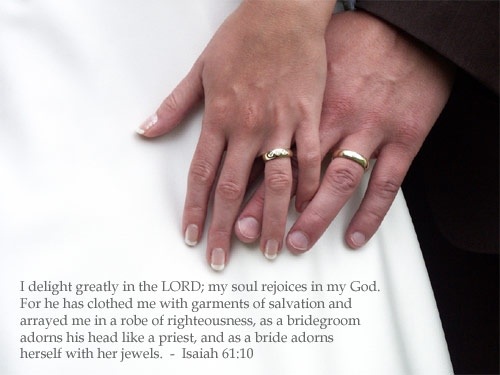
But does at carry over in any way to the New Covenant? Are we supposed to go outside and pile up some rocks and burn animals in sacrifice? No, in spite of what my barbecue may look like, burnt offerings are not for today. But I believe there is an “Altar Principle” in place that we would do well to remember. We already practice the Altar Principle when couples marry. The wedding rings serve as visual reminders of a spiritual covenant that was entered into, and in that way function as a kind of altar. The brides ring may even include a rock!

I’m not sure of the precise accuracy of these numbers but they are at least directionally correct. It has been said that students remember 25% of what they hear, 50% of what they hear and see, and 75% of what they hear, see, and participate in. This is especially true when repetition is added into the equation. I that way, the Lords Supper, or Communion Feast, exemplifies that principle. On a weekly basis we hear about what Jesus did, see the elements that represent the body and blood of Christ, and eat and drink together, the salvation message is reinforced in the hearts of believers. That is how the altar principle works.

When a married couple is being counseled, they can be told to look at their rings and remember the promises they once made to each other and to God. They serve as a point of reference for them and help them to focus on what is important. One huge danger sign is when either partner removes their wedding ring in public, so as not to be noticed. They are attempting to hide the sign of their covenant from sight so they will not be reminded that they are bound to another.

Baptism also has a altar principle attached to it. Paul would refer to the fact that believers had been baptized and remind them of what that meant.

What shall we say then? Are we to continue in sin so that grace may increase? May it never be! How shall we who died to sin still live in it? Or do you not know that all of us who have been baptized into Christ Jesus have been baptized into His death? Therefore we have been buried with Him through baptism into death, so that as Christ was raised from the dead through the glory of the Father, so we too might walk in newness of life. (Romans 6:1-4 NASB)

Paul is saying that when Christians are tempted to willfully sin, that baptism serves as a reminder that they have a new life in Christ and have been freed from sin, so with that in mind, how can we walk anymore in it? For that reason, we need to think back and remember our baptism and what it symbolized. We need to remember that we, too, have died, been buried, and risen with Christ.

I would recommend to anyone that they think back often of their conversion experience, and specifically their baptism. Use it as an altar, or a reference point in your life that you can point back to and remember what great things The Lord has done for you when He saved you from darkness and translated you into the Kingdom of the Son of His love.

20121110-001109.jpg