Posts tagged ‘God’

Offend In Jesus?

There is an interesting passage I have been meditating on that has always seemed odd to me. John the Baptist is a prophet whom I have always admired, especially since Jesus spoke so highly of him. But there is an incident that occurs when John is in prison that I have always interpreted as a time where he was having doubts about his ministry. That never made complete sense to me, since Jesus was the same man John had called “the Lamb of God who takes away the sins of the world”! After taking another look at the accounts in Matthew and Luke, I have come to another conclusion for you to consider. Let’s look at what Luke said.

When the men had come to Him, they said, “John the Baptist has sent us to You, saying, ‘Are You the Coming One, or do we look for another?’ ” And that very hour He cured many of infirmities, afflictions, and evil spirits; and to many blind He gave sight. Jesus answered and said to them, “Go and tell John the things you have seen and heard: that the blind see, the lame walk, the lepers are cleansed, the deaf hear, the dead are raised, the poor have the gospel preached to them. And blessed is he who is not offended because of Me.” (Luke 7:20-23 NKJV)

I think one problem was that I would stop at the end of verse 22. But in verse 23 Jesus not only reassures John that He is in fact the Messiah, but also reminds him to focus on the big picture of His mission, and not be offended because someone else is getting a miracle deliverance and seemingly John is not. What do I mean by that?

Well just a few chapters earlier in Luke, Jesus gets up to read in the synagogue from Isaiah and fulfills a prophetic picture of what His earthly ministry would be.

“The Spirit of the Lord is upon Me, Because He has anointed Me To preach the gospel to the poor; He has sent Me to heal the brokenhearted, To proclaim liberty to the captives And recovery of sight to the blind, To set at liberty those who are oppressed; To proclaim the acceptable year of the Lord.” (Luke 4:18, 19)

Jesus, by giving the answer He gave about the blind seeing, the deaf hearing, the lepers being cleansed, and the poor having the gospel preached to them, is reminding John of a couple of things.
1. It’s not about you.
2. Focus on and give thanks for what God is doing, not on what He is seemingly not doing.
I believe John asked the question, not because He was starting to doubt that Jesus was the Messiah, but because he knew the prophecy Jesus was fulfilling from Isaiah 61. John was trying to say, “the sick are healed, the lame walk, but what about delivering this captive?” And that is why Jesus added verse 23 to His reply to John’s disciples and reminded him not to be offended.

So what are some applications of this for us today?

Have you ever been striving for something in prayer with God? Maybe it was for restoration of health. Perhaps you were struggling financially, or were battling an addiction. And in the heat of the battle someone comes along that prays one time, and gets an instant reply. They quickly return to health, or get an inheritance from a long lost uncle, or are delivered from an addiction. Or a marriage or other family relationship is healed. While all of this is going on, you are still in the trenches doing battle and calling upon The Lord for deliverance. In times like these, it would be easy to resent what God has done for the other person rather than “rejoicing with those who rejoice”. Rather than focusing on what God has done and being thankful, we are tempted to turn inward and focus on what has not been done and become offended. This is dangerous ground, for a root of bitterness will defile us and those around us if we do not dig it out. (Hebrews 12:15) We are serving a Savior who has promised that He will never leave us, and will be with us always (Matthew 28:20) and that is a promise we can rest in.

Another application of this principle of not being offended when someone else gets an answer from God can be seen in two other miracles that Jesus performed. I would like to call attention to how these stories would have changed if resentment and bitterness had been harbored and offense had been taken.

In Luke chapter 8, Jairus comes and begs jesus to heal his little girl. When Jesus was walking with Jairus to his house to heal her, a ceremonially unclean woman with an issue of blood causes Jesus to stop when she reaches out, touches His garment, and is healed. While Jesus is ministering to her, Jairus’ servants come and tell him that his daughter had died. Can you imagine how different things would have been if he had become offended and lashed out in anger because this woman’s miracle had delayed Jesus from getting to his daughter before she died? He would have gone into unbelief and lost a daughter.

Or what about the man who was lame from birth, who sat at the Beautiful Gate by the temple in Acts 3? What if, when Peter and John mentioned the name of Jesus, the beggar had been offended because Jesus was a frequent visitor to the temple, and had healed thousands of people, but had never stopped and healed him? His miracle would literally have passed him by.

So don’t short circuit your answer from God by becoming offended when someone else’s prayers are answered. Rejoice with those who rejoice and gain courage from the knowledge that Jesus knows exactly what He is doing. Be heartened in the promise that He will never leave you or forsake you. You have not been abandoned. And in contentment, rest in the assurance that God is working all things together for good for saints like you that love Him. (Romans 8:28)

20130511-104208.jpg

Hope Fully Living

Hope is one of those words that can be difficult for someone to define. If you have hope, you know it. If you don’t, and are hopeless, you know that, too. But what is hope? How would you define it? More importantly, how does God define it in the Bible? Let’s take a look in Romans chapter 15.

Now may the God of hope fill you with all joy and peace in believing, that you may abound in hope by the power of the Holy Spirit. (Romans 15:13 NKJV)

The first thing we need to realize is that Jehovah is a God of hope. He has so much hope that it is a part of His very nature. That means He is the source of all hope for His children. Biblical hope can best be defined as “a confident expectation”. God does not wish for things. No, that implies that He is uncertain of the outcome and is just “hoping it all turns out right”. No, God knows the end from the beginning.

Declaring the end from the beginning, And from ancient times things that are not yet done, Saying, ‘My counsel shall stand, And I will do all My pleasure,’ (Isaiah 46:10)

God is the God of hope precisely because He is certain of the outcome of things that have not yet happened from our perspective. So we can anchor our hope in the one who isn’t up in heaven crossing His fingers and hoping for the best.

But how does God give that hope to us as His children? By “joy and peace in believing” (Romans 15:13). You see, nice we come to a realization of the nature and character of the One in whom we have placed our trust, we can experience deep joy. Because of what Christ accomplished for us on the cross, we now have access to God. In prayer and in reading, studying and meditating n His Word, we can daily come into his presence and have that faith built up and our hope reaffirmed. As The psalmist David wrote:

You will show me the path of life; In Your presence is fullness of joy; At Your right hand are pleasures forevermore. (Psalms 16:11)

We not only have joy, but with God, we have fullness of joy!

Whom having not seen, ye love; in whom, though now ye see him not, yet believing, ye rejoice with joy unspeakable and full of glory: (1 Peter 1:8 KJV)

Another byproduct of the hope we have in God is peace. Even in the midst of life’s darkest hour, we can be at peace with God. We have a calm assurance that God is on our side because if He was willing to save us by His death, He will also see that work through to the end by His life, and constant intercession for us. God gave us grace to save us, but that same grace goes on to change us as well.

For if, when we were enemies, we were reconciled to God by the death of his Son, much more, being reconciled, we shall be saved by his life. (Romans 5:10 KJV)

So as we increase in peace and joy, we increase in hope. They all go together and build upon each other. So no matter what you are going through (and some of us are really going through it), even if it is the valley of the shadow of death, we need not fear, for God is with us (Psalm 23). We know that we receive our hope from Him who is the very “God of hope” and can rest in His love and will for us.

that by two immutable things, in which it is impossible for God to lie, we might have strong consolation, who have fled for refuge to lay hold of the hope set before us. This hope we have as an anchor of the soul, both sure and steadfast, and which enters the Presence behind the veil, where the forerunner has entered for us, even Jesus,(Hebrews 6:18-20a NKJV)

20130422-232618.jpg

Our Covenant Keeping God

Throughout history, Jehovah has always dealt with mankind according to covenants. He is a God of order, and does not rule in an arbitrary or capricious manner. Rather, He lets us know the conditions of His covenant so that we know what His promises are and can then exercise faith in His Word to us. Thus, Jehovah establishes covenant relationships and has signs to serve as a reminder of that covenant. Unfortunately, due to the divisions of our Bibles into Old and New Testaments, there is a common misperception that there are only two covenants. In fact, there are three covenants contained in the Hebrew Scriptures and one in the Greek Scriptures.

The first covenant, one that is still in force, is the Noahic covenant. It was established between God and Noah after the flood.

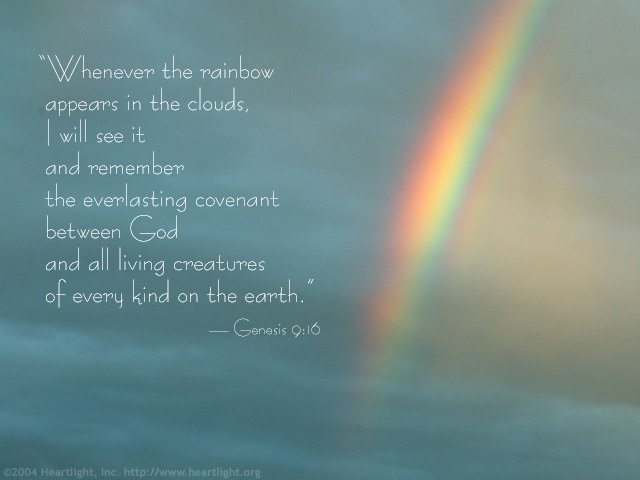
“And as for Me, behold, I establish My covenant with you and with your descendants after you, and with every living creature that is with you: the birds, the cattle, and every beast of the earth with you, of all that go out of the ark, every beast of the earth. Thus I establish My covenant with you: Never again shall all flesh be cut off by the waters of the flood; never again shall there be a flood to destroy the earth.” And God said: “This is the sign of the covenant which I make between Me and you, and every living creature that is with you, for perpetual generations: I set My rainbow in the cloud, and it shall be for the sign of the covenant between Me and the earth. (Genesis 9:9-13 NKJV)

I am thankful that this is in effect, as another worldwide flood would be a bummer. The sign of this covenant is the rainbow, and still occurs today. In Hawaii, it occurs on a daily basis! This covenant is also one that is unconditional, and was entered into after Noah sacrificed an animal on the altar in worship. Thus it was established by the shedding of blood.

The next covenant I want to consider is the Abrahamic covenant. In this one, God covenants with Abraham to give his descendants through Isaac possession of the land of Israel perpetually. Jehovah also promised that through Abraham’s seed (Jesus) all nations will be blessed. This covenant is also unconditional, and is still in force. In fact, those of us who have been reconciled unto God by His Son are those who are part of “the blessed.”

Now the Lord had said to Abram: “Get out of your country, From your family And from your father’s house, To a land that I will show you. I will make you a great nation; I will bless you And make your name great; And you shall be a blessing. I will bless those who bless you, And I will curse him who curses you; And in you all the families of the earth shall be blessed.” (Genesis 12:1-3)

On the same day the Lord made a covenant with Abram, saying: “To your descendants I have given this land, from the river of Egypt to the great river, the River Euphrates— the Kenites, the Kenezzites, the Kadmonites, the Hittites, the Perizzites, the Rephaim, the Amorites, the Canaanites, the Girgashites, and the Jebusites.” (Genesis 15:18-21)

Again, there were no conditions listed, and the covenant was sealed with a blood sacrifice.

The next covenant was the Mosaic covenant, made between Jehovah and the nation of Israel. This covenant was conditional unlike the others. It is within this covenant that most of the Bible is given. This covenant was given at Mount Sinai and was in force until John the Baptist (Luke 16:16). The covenant, though perfect from God’s side, was beyond human ability to fully keep. It was designed to be temporary, and served to condemn the world under sin. The sign of the Mosaic covenant was circumcision. This covenant was fulfilled at the cross when Jesus Christ ushered in the New Covenant with the shedding of His own blood. While the Mosaic covenant has been fulfilled and is not in force, but in no way does that negate the Noahic or Abrahamic covenants.

The current covenant is the covenant of Grace. It was also initiated by the shedding of blood, but this time by the perfect sacrifice of Jesus on the cross. The sign of our New Covenant are both internal and external. Internally, we experience circumcision of the heart at baptism (Colossians 2:12), and externally we show the covenant to others when we partake of the elements of communion on the first day of the week. What is the significance of this? It is that we are in covenant relationship with Jehovah God, whose nature is that of a covenant maker and keeper. He is not going to change His mind and decide to cancel our covenant. We are secure in Christ. No one is ever lost because God abandoned them or lost them. Jesus doesn’t fire people; they quit on Him! His part of the covenant is completed. We only need to accept the offer of salvation as He has prescribed, and walk in covenant obedience to Christ.

Now may the God of peace who brought up our Lord Jesus from the dead, that great Shepherd of the sheep, through the blood of the everlasting covenant, make you complete in every good work to do His will, working in you what is well pleasing in His sight, through Jesus Christ, to whom be glory forever and ever. Amen. (Hebrews 13:20, 21)

20130409-001245.jpg

Awe-Full Worship

Worship is at once a simple thing and a complex thing. There are aspects of worship that we may never fully comprehend here below, but we have eternity to explore. While worship includes aspects such as rejoicing, thanksgiving and proclamation of the goodness of God, I wonder if we are not missing an essential element in the church world today. What I am suggesting is not that there is anything wrong with those aspects of our worship, but that we have forgotten a key ingredient, which can only be cultivated through intimacy with Jesus Christ. That element is awe.

Awe has its roots in accurate knowledge of the character and attributes of God. It begins with a sense of reverence. But when it really comes to life is when we know God, not just a set of facts about Him. As in other things, data does not equal knowledge. Awe blossoms when we come to a realization of who God is and who we are. When we have God high and lifted up, and realize that the only reason we can worship Him at all is because of grace, we begin to experience “awe”. The Hebrew writer out it this way at the end of chapter 12:

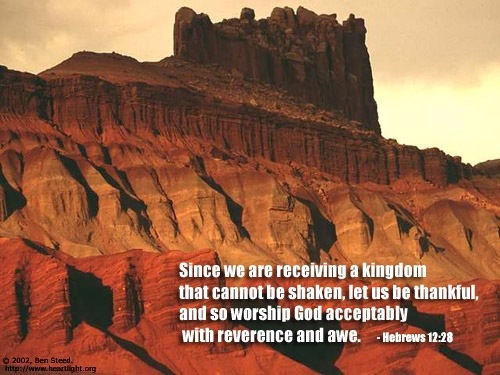
But you have come to Mount Zion and to the city of the living God, the heavenly Jerusalem, and to myriads of angels, to the general assembly and church of the firstborn who are enrolled in heaven, and to God, the Judge of all, and to the spirits of the righteous made perfect, and to Jesus, the mediator of a new covenant, and to the sprinkled blood, which speaks better than the blood of Abel. See to it that you do not refuse Him who is speaking. For if those did not escape when they refused him who warned them on earth, much less will we escape who turn away from Him who warns from heaven. And His voice shook the earth then, but now He has promised, saying, “Y et once more I will shake not only the earth , but also the heaven .” This expression, “Yet once more,” denotes the removing of those things which can be shaken, as of created things, so that those things which cannot be shaken may remain. Therefore, since we receive a kingdom which cannot be shaken, let us show gratitude, by which we may offer to God an acceptable service with reverence and awe; for our God is a consuming fire. (Hebrews 12:22-29 NASB)

When we bow before the immovable, unshakeable, consuming fire, who dwells in unapproachable light, our sense of awe will cause us to be broken and contrite before Him. We will be in awe of His supreme condescension in emptying Himself, taking the form of a servant, and coming to suffer for our sins while we were still His enemies. “The Message” renders it this way:

Think of yourselves the way Christ Jesus thought of himself. He had equal status with God but didn’t think so much of himself that he had to cling to the advantages of that status no matter what. Not at all. When the time came, he set aside the privileges of deity and took on the status of a slave, became human! Having become human, he stayed human. It was an incredibly humbling process. He didn’t claim special privileges. Instead, he lived a selfless, obedient life and then died a selfless, obedient death—and the worst kind of death at that—a crucifixion. Because of that obedience, God lifted him high and honored him far beyond anyone or anything, ever, so that all created beings in heaven and on earth—even those long ago dead and buried—will bow in worship before this Jesus Christ, and call out in praise that he is the Master of all, to the glorious honor of God the Father. (Philippians 2:5-11 MSG)

But let me call your attention to what was said in Hebrews 12. The Writer describes “acceptable worship” as having the key ingredients of reverence and awe. Back in Isaiah, God revealed that those are the only worshiped that get His attention. And keep in mind here, that He is specifically talking about worship.

Thus says the Lord , “Heaven is My throne and the earth is My footstool. Where then is a house you could build for Me? And where is a place that I may rest? “For My hand made all these things, Thus all these things came into being,” declares the L ord . “But to this one I will look, To him who is humble and contrite of spirit, and who trembles at My word. (Isaiah 66:1, 2 NASB)

There is no shortcut to awe. Is not something that can be drummed up by a worship leader working the crowd and “pumping you up”. Oh, we can appear humble and broken, and even shed a tear. But let’s not confuse that with awe. Awe is what causes us to tremble at His Word. Awe is what fosters the fear of The Lord in our soul and spirit.

So lets make a concerted effort to focus on who our God is. As we meditate on this “consuming fire” lets realize that if it were not for His mercy, we would be consumed by that very fire instead of being welcomed by it.

This I recall to my mind, therefore have I hope. It is of the Lord’s mercies that we are not consumed, because his compassions fail not. They are new every morning: great is thy faithfulness. (Lamentations 3:21-23 KJV)

Here is something to meditate on for a day. Roll this one around in your head for awhile: “My God is a consuming fire.”

20121228-014122.jpg

The Immutable God

The attributes of God are a fascinating study. Among those attributes is one I find very comforting. This is the immutability of God. In short, immutability means that God does not change. And that makes sense because of His perfection. As the ultimate in perfection, any change would represent something inferior in nature. God said it this was through the prophet Malachi:

For I am the Lord, I change not; (Malachi 3:6a KJV)

This unchanging nature is also attributed to Jesus Christ in the letter to the Hebrews.

Jesus Christ the same yesterday, and to day, and for ever. (Hebrews 13:8 KJV)

But what are the implications of this attributes for us as believers?

God will not change His mind about our salvation.
Jesus Christ is not a fickle savior. He does not save us only to change His mind when we don’t measure up. Some may quit on God, but they are not lost because He kicks them out. They are lost because they left.

For I am persuaded, that neither death, nor life, nor angels, nor principalities, nor powers, nor things present, nor things to come, Nor height, nor depth, nor any other creature, shall be able to separate us from the love of God, which is in Christ Jesus our Lord. (Romans 8:38, 39 KJV)

God will not change His Word.
The words that have been spoken by God are eternal. God cannot lie, if for no other reason than whatever He says instantly becomes reality! If you are standing on the promises of God found in His Word, then you can rely on those promises because God’s Word is immutable!

Forever, O Lord, Your word is settled in heaven. Your faithfulness endures to all generations; You established the earth, and it abides. (Psalm 119:89, 90 NKJV)

For verily I say unto you, Till heaven and earth pass, one jot or one tittle shall in no wise pass from the law, till all be fulfilled. (Matthew 5:18 KJV)

God does not change His mind about worship.
When God indicates that He desires and blesses acts of worship, He does not come along later and decide He doesn’t like them any more. Well what about the sacrifices of animals in the Law of Moses? Surely God no longer desires or requires that, does He? Well yes, the principle still stands. Without the shedding of blood there is no forgiveness of sin (Hebrews 9:22).
When God says to sing praises to His name, He still delights in such. When the Psalms speak of praising The Lord with instruments (Psalm 150), He has not reversed His preferences and decided it is now a sin to do so. Worship is about what God wants, not what we want, and is based on His immutable nature.

God doesn’t decide that our case is too difficult
No matter what situations and circumstances life throws at us, we can rest in the immutability of God. God is our anchor and a rock that we can rely upon.
And so we love, honor, and worship the unchanging One as we go through the struggles of life.

The eternal God is your refuge, And underneath are the everlasting arms; (Deuteronomy 33:27a NKJV)

God is the One we can count on to be constant and sure. So let us place our trust and faith fully in His unchanging character to carry us through.

20121020-005412.jpg

Absolutely Nothing

Have you ever struggled to do something, only to have someone else come by and do it like it was easy? It can definitely be a humbling experience. But when you have someone on your side that can handle anything that comes your way, it inspires confidence and trust in all who follow him. Jeremiah the prophet had just that sort of confidence in his God, and said so when he prayed.

‘Ah Lord GOD! Behold, You have made the heavens and the earth by Your great power and by Your outstretched arm! Nothing is too difficult for You, (Jeremiah 32:17 NASB)

Truly, nothing is too difficult for our God. What does that mean for us as His children?

There is no temptation that God cannot provide a way of escape from.
No matter what our adversary throws at us, our God provides a way of escape for us. We will never encounter a situation and find that we have no choice but to sin.

No temptation has overtaken you but such as is common to man; and God is faithful, who will not allow you to be tempted beyond what you are able, but with the temptation will provide the way of escape also, so that you will be able to endure it. (1 Corinthians 10:13 NASB)

Of course, if we continually refuse to take those escapes, we can put ourselves into a trap. But we have to purposely refuse to escape for that to happen.

There is no problem that God cannot preserve us through.
The Lord’s rescues come in at least two ways. He either takes away the problem, or enables us to persevere through it.
When Peter was in prison and scheduled to be executed, God rescued him with an angelic escort, in response to the prayers of his fellow believers. (Acts 12:1-19)
But when Paul was afflicted by a messenger of satan he pleaded with The Lord to remove it from him. After the third time, instead of removing the thorn in the flesh, God supplied grace sufficient for him to bear it (2 Corinthians 12:7-10)
The point is, that no matter what happens, God is faithful to cause us to persevere.

There is no sin that God is not willing and able to forgive.
The blood that Jesus shed is of sufficient value to pay for every sin that has been or ever will be committed.

and He Himself is the propitiation for our sins; and not for ours only, but also for those of the whole world. (1 John 2:2 NASB)

Jesus has made peace for us with God by the blood that he offers in the heavenly most holy place. (Colossians 1:20; Hebrews 10:14)
The price has been paid, and we now have access to God. We have been saved to the uttermost!

I am sure there is more that God can do.
Paul put it this way:

Now to Him who is able to do exceedingly abundantly above all that we ask or think, according to the power that works in us, (Ephesians 3:20 NKJV)

It would be enough if God could do all that we ask or think. But it is more than that. He can do above all we can ask or think. No, wait. It is on a higher level. He can do abundantly above all we can ask or think. Not being satisfied, Paul takes it to an exponentially greater power. God is able to do exceedingly, abundantly, above, all!

That is the God we serve and who is on my side and your side! And so we conclude as Paul did:

to Him be glory in the church by Christ Jesus to all generations, forever and ever. Amen. (Ephesians 3:21 NKJV)

20120927-004621.jpg

The Power of the Word of God

Words are vehicles which carry thoughts. They are a way of informing, but also a window into the heart of the one who is speaking. Words also let someone else know how you operate so that they can know you more intimately. God has chosen to use words given through inspiration to convey to humanity His ways and His thoughts. God spoke about the power of His Words to Isaiah.

For my thoughts are not your thoughts,
neither are your ways my ways, declares the Lord.
For as the heavens are higher than the earth,
so are my ways higher than your ways
and my thoughts than your thoughts.

“For as the rain and the snow come down from heaven
and do not return there but water the earth,
making it bring forth and sprout,
giving seed to the sower and bread to the eater,
so shall my word be that goes out from my mouth;
it shall not return to me empty,
but it shall accomplish that which I purpose,
and shall succeed in the thing for which I sent it. (Isaiah 55:8-11 ESV)

He starts off talking about His thoughts, and let’s everyone know right away that His thoughts are on a higher level than ours are. And we are not talking about them being just out of reach. They are exponentially higher than our thoughts. So when we critique what God has said, or second-guess His ways, we can rest assured that we are completely unqualified to do so.

Then there is a transition to the containers of the thoughts of God, His Word. It is impossible for God to speak an idle word. Think about that. Every single word that goes forth from God has His power and creative force behind it, and is unalterable. No word of God ever returns back empty, indeed it cannot do so! (Have you ever stopped to contemplate the chaos that would ensue if every one of rout words had that power? Yikes!)
The writer of Hebrews puts it this way:

For the word of God is living and active, sharper than any two-edged sword, piercing to the division of soul and of spirit, of joints and of marrow, and discerning the thoughts and intentions of the heart. (Hebrews 4:12)

The created universe we see around us was created by that word.

By faith we understand that the worlds were framed by the word of God, so that the things which are seen were not made of things which are visible. (Hebrews 11:3 NKJV)

And that same world is held together by the power that is still resident within the One who is the Word made flesh, Jesus. (John 1)

And He is the radiance of His glory and the exact representation of His nature, and upholds all things by the word of His power. When He had made purification of sins, He sat down at the right hand of the Majesty on high, (Hebrews 1:3 NASB)

But how do we access that powerful word today? Where would we find it?
Here’s a hint:

All Scripture is God-breathed and is useful for teaching, rebuking, correcting and training in righteousness, so that the servant of God may be thoroughly equipped for every good work. (2 Timothy 3:16, 17 NIV)

We can have complete confidence in the wisdom, veracity, and power of the Word of God. There is no need to subject it to the criticism of men, since it’s divine Author is so far above our thoughts and ways. Ours is simply to have faith in what He has revealed and walk in the ways He has prescribed for His children. When we do so, we have the most powerful force in or out of the universe behind us!

20120924-184818.jpg

God Has A Plan For Israel continued

As we move later into Romans chapter 11, we find the theme for this passage.

For this is My covenant with them, When I take away their sins. Concerning the gospel they are enemies for your sake, but concerning the election they are beloved for the sake of the fathers. For the gifts and the calling of God are irrevocable. (Romans 11:27-29 NKJV)

The rejection of Israel is temporary, not because of effort or merit. The eventual re-grafting of Israel is based completely on the nature of God. While humans may change their minds or dissolve a contract, God is perfect and His word is unalterable. Once God makes an unconditional promise, He will never renege on it. To do so would mean His promise was less than perfect. And God made these covenant promises with full knowledge of what would happen in the future. God has no “Plan B” and He will never need one.

In the previous verses, Paul reiterates the temporary nature of Israel’s blindness.

For I do not desire, brethren, that you should be ignorant of this mystery, lest you should be wise in your own opinion, that blindness in part has happened to Israel until the fullness of the Gentiles has come in. And so all Israel will be saved, as it is written: The Deliverer will come out of Zion, And He will turn away ungodliness from Jacob; (Romans 11:25, 26 NKJV)

Who is the group being referred to as “all Israel” here? It is made up of the true children of Abraham. Those who have faith, whether born as Gentiles or Jews. And there will come a day when the last of the Gentiles who God foreknows will obey the Gospel is saved, and the blindness is taken away, and masses of Jews turn to the Messiah and are grafted back into the olive tree.

For as you were once disobedient to God, yet have now obtained mercy through their disobedience, even so these also have now been disobedient, that through the mercy shown you they also may obtain mercy. For God has committed them all to disobedience, that He might have mercy on all. (Romans 11:30-32 NKJV)

Just as we, as Gentiles, we’re once lost and walking in disobedience, and received mercy for salvation, God will cause Israel to turn from their disobedience because of His mercy. Thus, God will have saved both groups for one reason alone. Because He decided to do it!
Paul makes it clear that we are not qualified to determine the reasons God does things. It’s not about us, or what we think should happen. God’s ways are beyond our ability to fully fathom.

Oh, the depth of the riches both of the wisdom and knowledge of God! How unsearchable are His judgments and His ways past finding out! For who has known the mind of the Lord? Or who has become His counselor? Or who has first given to Him And it shall be repaid to him? For of Him and through Him and to Him are all things, to whom be glory forever. Amen. (Romans 11:33-36 NKJV)

It’s not about us. It’s about the glory of God. Period! And so both groups, Jew and Gentile alike, will fulfill the plan of God together. We can’t do it without them, and they can’t complete it without us. I will finish this one with what the Hebrew writer said:

And these all were commended for their faith, yet they did not receive what was promised. For God had provided something better for us, so that they would be made perfect together with us. (Hebrews 11:39, 40 NET)

20120906-002612.jpg

All The Revelation We Need

Many times these days I hear someone talk about getting a new revelation from God. Or groups will claim that God is yet revealing many new things (usually only to their leader). Is this possible? Is God still sending new revelation about Himself to mankind? The writer of the letter to the Hebrews would disagree.

God, who at various times and in various ways spoke in time past to the fathers by the prophets, has in these last days spoken to us by His Son, whom He has appointed heir of all things, through whom also He made the worlds; (Hebrews 1:1, 2 NKJV)

At the start of this rich letter, the author addresses the subject of revelation from God by showing that Jesus is a superior revelation than what had been received in the past. In the Old Testament, revelation was progressive and was received bit by bit until the truth was complete. As the Lord told Isaiah, “For it is precept upon precept, precept upon precept, line upon line, line upon line,
here a little, there a little.” (Isaiah 28:10 ESV)

Notice, too, that the writer says that this was accomplished in the past tense. What is necessarily implied here is that this method of revelation, prophets, was no longer being used. So much for having a living prophet or an organization that is the conduit of divine revelation today. No, because we now have the complete revelation that is to be provided. It is a superior revelation that makes the other method obsolete. In fact it is not a method, but is now a person. Verse 1 states that God has now spoken to us by means of a Son — Jesus.

Jesus Christ is the full revelation of The Father, and as such, we need no other. In verse 3, the writer says of this Son that he is the exact representation of His (God’s) nature. Paul says the same thing in Colossians chapter 1:15 when he describes Jesus as “the image of the invisible God.” Do you want to know what God is like? What His nature is? Then go to Jesus, for the fullness of the Godhead dwells within Him in bodily form and you need look no further.

For in Him dwells all the fullness of the Godhead bodily; and you are complete in Him, who is the head of all principality and power. (Colossians 2:9, 10 NKJV)

Do you want to obtain wisdom and knowledge from God? You will only find it in Jesus, ” in whom are hidden all the treasures of wisdom and knowledge.” (Colossians 2:3 NASB) So if you want to know what God has revealed for us to know, you will only find it in Jesus! A search for the Word of God begins and ends at the feet of the One who was and is Word made flesh (John 1:1-14)

In fact, there is spiritually mortal danger in going beyond the revelation and teaching found in Jesus.

“Everyone who goes on ahead and does not abide in the teaching of Christ, does not have God. Whoever abides in the teaching has both the Father and the Son.” (2 John 1:9 ESV)

Jesus is not only all of the revelation we need, He is all the revelation there is! He is the complete revelation of God, and we have no need to look elsewhere!

20120903-095540.jpg

God Listens To Abba

Many children have terms of endearment for their parents and grandparents. While these names may not make sense to an outsider, to those inside the relationship those names evoke the fondest of memories. One such term that is used in the New Testament is “Abba” and it means “daddy”.

The term Abba conveys a sense of utter trust and intimacy between a child and a father. So much so that it is even carried on into adulthood. It was in the Garden as Jesus prayed on the night he was betrayed, “Abba! Father! All things are possible for You; remove this cup from Me; yet not what I will, but what You will.” (Mark 14:36 NASB) In His hour of deepest sorrow and emotional pain, Jesus cries out to the Father with the most intimate name he knows – Abba. While His Father is high and exalted above all the universe, He is also “Daddy”.

I read the story of a tourist in Israel years ago who was walking with his tour guide in a residential neighborhood. As the walked, they saw a man park his car in front of a house. Immediately two small children ran out the front door to welcome him home from work, crying out “Abba! Abba!” until he hugged and kissed them and carried them back into the house.

It is that same spirit that we have as Christians in our hearts, because God is now our Father and we are his children. Paul wrote about that relationship in letters to Rome and the churches in Galatia.

For you did not receive the spirit of slavery leading again to fear, but you received the Spirit of adoption, by whom we cry, “Abba, Father.” (Romans 8:15 NET)

And because you are sons, God sent the Spirit of his Son into our hearts, who calls “Abba! Father!” (Galatians 4:6 NET)

Think about that! We now have the privilege of using the intimate name that Jesus himself used when addressing is Father! And because of the love relationship we have with God, we can call Him Abba because we have been brought into the family as adopted children.

I think that is what the Hebrew writer had in mind when he said this:

Let us therefore come boldly to the throne of grace, that we may obtain mercy and find grace to help in time of need. (Hebrews 4:16 NKJV)

We don’t have the boldness of a trusted advisor or even a daily servant. We have the same boldness to enter into His presence as the King’s children have. It is not based on talent, experience, or status. We can come to our Abba Father at any time simply because He is our Daddy and we know how much He loves us!

The Apostle John summed it up best:

See what great love the Father has lavished on us, that we should be called children of God! And that is what we are! The reason the world does not know us is that it did not know him. Dear friends, now we are children of God, and what we will be has not yet been made known. But we know that when Christ appears, we shall be like him, for we shall see him as he is. (1 John 3:1, 2 NIV)

20120820-004026.jpg