Posts tagged ‘faith’

Faith Without Conditions

Faith. It is a fruit of the Spirit that is essential to our spiritual progress, and even our salvation. Much is said in the Scriptures about having faith enough to receive whatever we ask of The Lord. And it is correct to say that God rewards the faith of those who diligently seek Him.

But there is a deeper level of faith than the one required for receiving an affirmative answer to our requests. A question we all need to consider is this: “Do I have enough faith to get a ‘no’ from God?” Please let me illustrate what I mean.
If you are faced with a terminal illness, do you have enough trust and faith in God to continue to follow Him if you are not healed? Do you trust Him enough to die if that is His will? I submit to you that this takes more faith than receiving an instant healing.

That kind of faith was shown by the three Hebrew young men who refused to worship the golden statue of the king.

If that is the case, our God whom we serve is able to deliver us from the burning fiery furnace, and He will deliver us from your hand, O king. But if not, let it be known to you, O king, that we do not serve your gods, nor will we worship the gold image which you have set up.” (Daniel 3:17, 18 NKJV)

Did you catch what they said? They believed that God could protect them, but were determined to follow His commandments even if their deliverance did not come. That is the kind of faith God is looking for — unconditional faith! I think it was there “no matter what” attitude that helped them to be delivered from the fiery furnace without even a hint of smoke on them. You see, faith is not belief without evidence; it is obedience without reservation.

In the Gospels, Jesus showed that same kind of faith in the Garden of Gethsemane.

He went a little farther and fell on His face, and prayed, saying, “O My Father, if it is possible, let this cup pass from Me; nevertheless, not as I will, but as You will. ” (Matthew 26:39 NKJV)

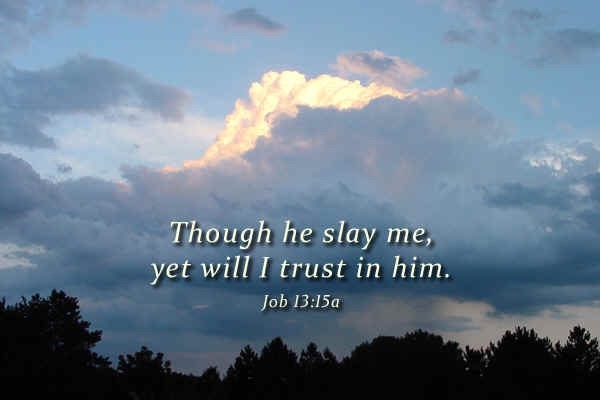
Jesus’ depth of faith and trust was displayed by His willingness to receive form The Father whatever the divine will entailed. It involved subordinating His own will to that of the Father. It begs the question about our own faith. Am I willing to not shrink back in my faith if it means the will of God leads through the valley of the shadow of death? When it all comes down to it, will we be able to say what Job said? “Though He slay me, yet will I trust Him (Job 13:15a).”

Too often today, the lost are told that they need to come to Christ because of all the things He will do to make life better for them. It’s a “me” centered message that is both harmful and unbiblical. Television preachers talk incessantly about how healing or deliverance hinges on how much faith they have. But salvation is not about having “our best life now” or being a success in business. It is about complete and utter surrender to the will of God, no matter where that leads us. That is why we need to be able to put aside what we desire and accept what He desires without reservation.

20130330-004916.jpg

Real Faith Works!

Ever since the days of the Reformation, there has been a strong emphasis on teaching that salvation is by faith. Given the unhealthy stress placed on works at the time, this was a normal reaction. What is needed is a healthy, and accurate, view of the relationship between faith and works if we are to be spiritually healthy and balanced. When James, the Lord’s brother, wrote his letter, the Spirit inspired him to address the subject this way:

Even so faith, if it has no works, is dead, being by itself. But someone may well say, “You have faith and I have works; show me your faith without the works, and I will show you my faith by my works.” You believe that God is one. You do well; the demons also believe, and shudder. But are you willing to recognize, you foolish fellow, that faith without works is useless? (James 2:17-20 NASB)

There is no contradiction here with the message the apostle Paul would later give to the church at Ephesus. Read carefully what Paul wrote:

For by grace you have been saved through faith; and that not of yourselves, it is the gift of God; not as a result of works, so that no one may boast. (Ephesians 2:8, 9)

He is saying, correctly, that our salvation does not come from our performance, or from working our way to God. No one can will ever be able to say that God owes them salvation. But also notice what Paul goes on to say in verse 10.

For we are His workmanship, created in Christ Jesus for good works, which God prepared beforehand so that we would walk in them. (Ephesians 2:10)

We were created in Christ when we are born again, for the uprise of good works. Do you see the order here? The works don’t cause faith and salvation; the faith and salvation produce the works! Furthermore, God has it planned that way.

God always connects a truth to believe with a command to obey. While “faith” and “obedience” can be defined as separate terms, they are inseparable as realities. To put it succinctly, real faith, works!
That being said, faith has to come first. We can have works without having faith (i.e. dead works), but we cannot have faith without works. Build your faith and the works will follow. It is a trap to suppose that we can reverse the polarity of our spiritual power by putting works as a higher priority than cultivating intimacy with God and strengthening our faith.

For we through the Spirit, by faith, are waiting for the hope of righteousness. For in Christ Jesus neither circumcision nor uncircumcision means anything, but faith working through love. (Galatians 5:5, 6)

20121114-235336.jpg

Circumcision of the Heart

The Old Testament is replete with types and shadows that were fulfilled in Jesus Christ. One of those Old Testament symbols of the covenant was circumcision. Circumcision was so integral to the Old Covenant that the concept of an uncircumcised Jew was unheard of.

In Paul’s letter to the church at Colossae, he says that baptism is the spiritual fulfillment of circumcision.

In him also you were circumcised with a circumcision made without hands, by putting off the body of the flesh, by the circumcision of Christ, having been buried with him in baptism, in which you were also raised with him through faith in the powerful working of God, who raised him from the dead. (Colossians 2:11, 12 ESV)

Now that we are in the New Covenant with Christ, we experience a circumcision that is spiritual and of the heart. And according to Paul, this spiritual circumcision occurs at baptism. Fittingly, the concept of an unbaptized Christian is just as foreign to the New Testament as an uncircumcised Jew was to the Old Testament.

But is this verse in Colossians saying that baptism is what saves us? Well, was Abraham declared righteous before being circumcised or afterwards? According to Romans chapter 4, at what point was Abraham declared righteous?

“Blessed are those whose lawless deeds are forgiven,
and whose sins are covered;
blessed is the man against whom the Lord will not count his sin.”
Is this blessing then only for the circumcised, or also for the uncircumcised? We say that faith was counted to Abraham as righteousness. How then was it counted to him? Was it before or after he had been circumcised? It was not after, but before he was circumcised. (Romans 4:7-10 ESV)

It was Abraham’s faith that caused him to obey the commandment of God and be circumcised, and it would be accurate to say that if Abraham had refused to obey God that he did not have faith. His obedience proved his faith. In the same way, we are declared righteous when we have faith, and that faith is proven, or validated, by our submitting to baptism.

Thus, salvation is by faith, and that faith is shown by our baptism. Righteousness comes by faith, and is not of works. We are saved by faith, not by faith plus a ritual. But that sign of the covenant must not be diminished or disregarded, either. Just as faith without obedience is out of context, obedience without faith is useless as well. But the connection of the old circumcision to baptism is clear. And Abraham was declared righteous because he believed God before he was circumcised. In the same way, we are declared righteous when we believe, and we submit to the sign of our covenant relationship when we are baptized. Failure to do so proves we didn’t really believe in the first place.

20121019-003123.jpg

In the Glory Land Way

Navigation systems.
Seems like nowadays we have to have them. They are useful, when the work correctly. But many things can go wrong. Sometimes, if you put in that you want to go to Appleton, you have to make sure you specify the one in Wisconsin. Following directions to Appleton, Illinois will not get you home any time soon!

We are all on a journey, and we need to make sure we are on the correct path, and also in the right kind of vehicle if we are to arrive at our desired eternal destination.

The onramp: Salvation
Before we are delivered from sin, we are all on the wrong road. It is a very wide and spacious road, and no one gets in your way. Most folks are on it, and who are we to say that they are wrong? Right? Well Jesus said otherwise.

“Enter through the narrow gate; for the gate is wide and the way is broad that leads to destruction, and there are many who enter through it. For the gate is small and the way is narrow that leads to life, and there are few who find it. (Matthew 7:13, 14 NASB)

The vehicle: Grace
In Ephesians 2:8-9, Paul wrote that we are saved “by grace through faith” so I am making grace the vehicle, and faith the engine. For after we are saved, we must remain in grace in order to make it to our heavenly home. At no point in the journey are we ever without the need for grace. So now we have the vehicle, and discovered as well that it is ours as a gift! So how do we make it go?

The Engine: Faith
We must have faith to make any progress on our Christian journey. And faith we must have, without faith we cannot please God, nor receive the reward for those who diligently seek him.

And without faith it is impossible to please Him, for he who comes to God must believe that He is and that He is a rewarder of those who seek Him. (Hebrews 11:6 NASB)

But how do we get this faith and make it strong? By taking in the Word of God!

So faith comes by hearing, and hearing by the word of God. (Romans 10:17 WEB)

So we now know we need faith for an engine, and we know where to get it. Now we need some fuel.

The Fuel: Love
The fuel our faith engine runs on is love.

For in Christ Jesus neither circumcision amounts to anything, nor uncircumcision, but faith working through love. (Galatians 5:6 WEB)

For this reason I too, having heard of the faith in the Lord Jesus which exists among you and your love for all the saints, (Ephesians 1:15 NASB)

I cannot emphasize enough the importance of love. Without it, your entire journey is for nothing. Nothing else matters if you don’t mix it with love.

so that Christ may dwell in your hearts through faith; and that you, being rooted and grounded in love, (Ephesians 3:17 NASB)

We have our vehicle, the engine is in, the tank is fueled, and will continue to be refilled, with love. What kind of highway are we supposed to drive on?

The Road: Patience
Back in Matthew 7 we saw that the road is narrow and few people will find it. Once we are on this narrow road, what kind of road is it? It is a road of patience. If we were to receive everything instantly, we would have little opportunity to build our character. It is in the waiting that we learn to trust God.

so that you may not be sluggish, but imitators of those who through faith and patience inherit the promises. (Hebrews 6:12 ESV)

Yes, our final salvation must be hoped for with patience.

For in this hope we were saved. Now hope that is seen is not hope. For who hopes for what he sees? But if we hope for what we do not see, we wait for it with patience. (Romans 8:24, 25 ESV)

Paul commended the Thessalonians for their patience, faith and love.

Remembering without ceasing your work of faith, and labour of love, and patience of hope in our Lord Jesus Christ, in the sight of God and our Father; (1 Thessalonians 1:3 KJV)

Now we are equipped for the journey. We have to remember that not of the things I have mentioned above are optional. They all are essential and there are no substitutes for them. Take away any of them, and the others are ineffective and/or nullified. If this is not a journey you have begun, or if you realize that you thought the journey had begun but find yourself on the broad road, come to Jesus and begin the journey on the narrow road. Get in the Glory Land Way!

20121012-234936.jpg

Lest You Become Weary

Whenever there is film of a marathon race, they like to show the participants as they get near to the end of the race. I have yet to see anyone stopping to do some shopping, or to play a quick game of basketball during the race. That doesnt happen because the runners are fully focused and what they need to do. I think that maintaining our focus is one of the reasons for our communion at the Lord’s Table every week as well. Hebrews 12 talks about things we can do when we take the bread and the fruit of the vine that will help of run with endurance.

Therefore we also, since we are surrounded by so great a cloud of witnesses, let us lay aside every weight, and the sin which so easily ensnares us, and let us run with endurance the race that is set before us, looking unto Jesus, the author and finisher of our faith, who for the joy that was set before Him endured the cross, despising the shame, and has sat down at the right hand of the throne of God. For consider Him who endured such hostility from sinners against Himself, lest you become weary and discouraged in your souls. (Hebrews 12:1-3 NKJV)

First, we take encouragement from those who have run the race before us. We also build one another up as we partake of the emblems each week together. This is not something we do alone. It is, as Paul described it in 1 Corinthians 10, a communion in the body and blood of Christ.

Second, we should reflect on our lives and determine that because of our love for Christ and our gratitude for the price he paid, we will lay aside every sin that so easily ensnares us. As we remember the brutality of the suffering that He endured, we are reminded of the awfulness of our sin and resolve to turn from it, lest we be ensnared in it again.

Third, we must focus on Jesus, who is our supreme example of endurance. Think about what He went through. Think about his focus stayed on the joy at the end, when he would be able to redeem his bride and spend eternity with us in heaven. And as we consider the hostility He endured for us, it will help us to endure the trials we go through and not become discouraged and weary. He died for me; I will live for him.

Take time today to focus on Jesus and what he has done and resolve anew to never quit, but rather to run with endurance and finish well.

20120909-084155.jpg

A Direct Cooperation With The Spirit

A very common teaching today is that no one can come to God without being acted upon by the Holy Spirit. It is taught that this action of the Spirit happens independent of human cooperation, and causes the sinner to be able to understand spiritual things and seek after God. Where do such doctrines come from? Let’s look at a few verses that seem to support this position.

No one can come to Me unless the Father who sent Me draws him; and I will raise him up on the last day. It is written in the prophets, ‘AND THEY SHALL ALL BE TAUGHT OF GOD.’ Everyone who has heard and learned from the Father, comes to Me. (John 6:44, 45 NASB)

But a natural man does not accept the things of the Spirit of God, for they are foolishness to him; and he cannot understand them, because they are spiritually appraised. But he who is spiritual appraises all things, yet he himself is appraised by no one. For WHO HAS KNOWN THE MIND OF THE LORD, THAT HE WILL INSTRUCT HIM? But we have the mind of Christ. (1 Corinthians 2:14-16 NASB)

If we just consider those passages, then the direct action teaching seems pretty solidly rooted in Scripture. But the problem is this; those are not the only verses on the subject, and we need to consider everything that has been revealed in the Word before coming to a conclusion.

If we agree that faith is required to please God, then we need to determine how faith is obtained. Paul said in Romans 10,

How then will they call on Him in whom they have not believed? How will they believe in Him whom they have not heard? And how will they hear without a preacher? How will they preach unless they are sent? Just as it is written, “HOW BEAUTIFUL ARE THE FEET OF THOSE WHO BRING GOOD NEWS OF GOOD THINGS!” However, they did not all heed the good news; for Isaiah says, “LORD, WHO HAS BELIEVED OUR REPORT?” So faith comes from hearing, and hearing by the word of Christ. (Romans 10:14-17 NASB)

Notice that the verse does not say that faith comes by election, but by hearing the Word of Christ. Paul confirms this when addressing the Galatians.

“This is the only thing I want to find out from you: did you receive the Spirit by the works of the Law, or by hearing with faith?” (Galatians 3:2 NASB)

From these two verses we can see that faith comes when a sinner hears the Word of Christ. This is also true because the Word of God is not a dead letter. It has inherent spiritual power within it.

“For the word of God is living and active and sharper than any two-edged sword, and piercing as far as the division of soul and spirit, of both joints and marrow, and able to judge the thoughts and intentions of the heart.” (Hebrews 4:12 NASB)

The Word of God, empowered by the Spirit in cooperation with faith growing in those who receive it, has the power to draw men to Christ and renew the mind. This is not limited to the salvation experience. This faith building and renewing of our minds is a lifelong journey of growth in the things of God.

So it is not a sovereign Divine act that enables sinners to come to God. It is, rather, a Divine cooperation with the Spirit that results in salvation.

20120807-004246.jpg

Just…Live…Faith

I believe it is significant when an Old Testament verse is quoted in the New Testament. When the verse is quoted twice, that is a big deal. But when a verse is quoted three times, with each instance in a different letter, there is a spiritual principle being taught that has a wider application. Habakkuk 2:4 is just such a verse.
But the just shall live by his faith. (Habakkuk 2:4b NKJV)
How appropriate that this little verse is quoted in Romans, Galatians, and Hebrews.

The Just:
For I am not ashamed of the gospel of Christ, for it is the power of God to salvation for everyone who believes, for the Jew first and also for the Greek. For in it the righteousness of God is revealed from faith to faith; as it is written, The just shall live by faith. (Romans 1:16, 17 NKJV)
If I had to sum up the message I’d Paul’s letter to the church in Rome in just one word, that word would be justification. For it is in Romans that we are shown when, where, and how justification by faith happens. The “how” is by faith, as the previous verse says. The where is in our hearts (Romans 5:1-5), and the “when” is at obedience in baptism (Romans 6:3-10).

Shall Live:
But that no one is justified by the law in the sight of God is evident, for the just shall live by faith. (Galatians 3:11 NKJV)

In Galatians we have been provided with practical instruction for Christian living. But are also told that “I have been crucified with Christ; it is no longer I who live, but Christ lives in me; and the life which I now live in the flesh I live by faith in the Son of God, who loved me and gave Himself for me.” (Galatians 2:20 NKJV)
I cannot help but see an implied reference to baptism here as well.

By Faith:
Now the just shall live by faith; But if anyone draws back, My soul has no pleasure in him. (Hebrews 10:38 NKJV)
There is an entire chapter in Hebrews talking about faith. We also see that without faith, it is impossible to please God. Feeding our faith is the key to not drawing back. Faith in God is the very source of our spiritual life, and if we quit on God, we are left with less than nothing. In fact, it would be better to have never begun with God.
“For it would have been better for them not to have known the way of righteousness, than having known it, to turn from the holy commandment delivered to them.” (2 Peter 2:21 NKJV)
In reality, in the vast majority of cases, salvation is not lost — it is left.

Do you want to be justified and have eternal life?then have faith in God. But how do we get faith? “So then faith comes by hearing, and hearing by the word of God.” (Romans 10:17 NKJV) Get into the Word of God and feed your faith. And once you are in Christ via obedience in baptism, continue to stay in the Word and let your mind be transformed.

20120804-003915.jpg

A Learning Experience

Jehovah God is omniscient, knowing all that is, all that has been, and all that will be. He has always been that way because it part of His divine nature. Jesus, in whom the fullness of deity dwells in bodily form, shares this attribute (Colossians 2:9). So why would the writer of Hebrews say something like this?

“Although He was a Son, He learned obedience from the things which He suffered. And having been made perfect, He became to all those who obey Him the source of eternal salvation”, (Hebrews 5:8, 9 NASB)

Jesus did something His heavenly Father had never done — He learned! As Almighty God, Jehovah had never needed to learn anything! But since Christ had “emptied himself” of His divine prerogatives in order to be incarnate and come to earth as a man, He grew and had to learn obedience. God has never needed to obey anyone, either!

If Jesus was without sin (and He was), the what does the writer mean when saying Christ was “made perfect”? Perfect here in the Greek is not talking about sinless moral perfection, but about completeness. To be our high priest, Jesus had to not only be fully God, but also fully man. He would have to be tempted in every way men are, yet without sin. This could only be a completed by learning to be obedient.

And because of the obedience He exhibited, Christ is the source of eternal salvation. To whom? Those who say a prayer of salvation? Those who, deep down, believe? Those who He has elected ahead of time and regenerated before they decided either way? No! He is the source of eternal salvation to only one group of people — those who obey Him! As I have said in previous posts, I am not saying we are not saved by faith, but rather that obedience is a part of faith, and without it faith is dead. Can you imagine how something dead and lifeless could transmit eternal life? Of course not!
If I were a reporter, I would summarize salvation this way:
Who saves us: Jesus Christ
What saves us: grace
How grace saves us: faith
When and where faith saves us: baptism
Why: His love for us.

I cannot think of a better way to summarize my thoughts than what was written by John Sammis in 1887 –“Trust and Obey”.

When we walk with the Lord in the light of His Word,
What a glory He sheds on our way!
While we do His good will, He abides with us still,
And with all who will trust and obey.

Refrain:
Trust and obey, for there’s no other way
To be happy in Jesus, but to trust and obey.

Not a shadow can rise, not a cloud in the skies,
But His smile quickly drives it away;
Not a doubt or a fear, not a sigh or a tear,
Can abide while we trust and obey.

Not a burden we bear, not a sorrow we share,
But our toil He doth richly repay;
Not a grief or a loss, not a frown or a cross,
But is blessed if we trust and obey.

But we never can prove the delights of His love
Until all on the altar we lay;
For the favor He shows, for the joy He bestows,
Are for them who will trust and obey.

Then in fellowship sweet we will sit at His feet,
Or we’ll walk by His side in the way;
What He says we will do, where He sends we will go;
Never fear, only trust and obey.

20120730-010238.jpg

The Opposite Of Belief

The Opposite Of Belief
In modern English usage, belief can be defined as mental assent to an idea. But what is belief in a biblical sense? Is it mere mental assent, or trust, or confession? One way to see what belief means in the Bible is to see what it is contrasted with. Let’s go to the foremost authority on the subject, Jesus Christ.
Whoever believes in the Son has eternal life; whoever does not obey the Son shall not see life, but the wrath of God remains on him. (John 3:36 ESV)
So according to Jesus, the opposite of belief is disobedience! In fact, belief and obedience are inextricably linked together. This link is so strong that to speak of belief or faith without stating or implying obedience is to take it out of context!
Even in Mark 16:16, where Christ says that, “he who believes and is baptized will be saved, and he who does not believe will be condemned” many teachers try to twist the verse to say that it refutes the essential nature of obedience (in this case baptism). But in fact, since obedience is implied whenever belief is mentioned, the verse in no way weakens the command to believe and be baptized!
So am I talking about a salvation by works? Of course not. In baptism, it is God who is doing the work of regeneration. When Paul speaks of works, he is usually referring to “works of the Law” and not obedience in faith. And he is correct! Law keeping has no power to save! But James speaks of works as a natural consummation of saving faith. Again, we are saved by faith in the resurrection of Christ, but that salvation is effected at baptism. (1 Peter 3:21)
So what is it that we are supposed to obey? The Gospel!
“in flaming fire, inflicting vengeance on those who do not know God and on those who do not obey the gospel of our Lord Jesus.” (2 Thessalonians 1:8 ESV). But what is the Gospel? According to Paul in 1 Corinthians 15, this is the Gospel:
“Now I would remind you, brothers, of the gospel I preached to you, which you received, in which you stand, and by which you are being saved, if you hold fast to the word I preached to you—unless you believed in vain. For I delivered to you as of first importance what I also received: that Christ died for our sins in accordance with the Scriptures, that he was buried, that he was raised on the third day in accordance with the Scriptures, and that he appeared to Cephas, then to the twelve.” (1 Corinthians 15:1-5 ESV)
But how does someone obey an event like the death, burial and resurrection?
According to Romans 6, it is done in baptism.
“We were buried therefore with him by baptism into death, in order that, just as Christ was raised from the dead by the glory of the Father, we too might walk in newness of life. For if we have been united with him in a death like his, we shall certainly be united with him in a resurrection like his. We know that our old self was crucified with him in order that the body of sin might be brought to nothing, so that we would no longer be enslaved to sin.” (Romans 6:4-6 ESV)

When we participate in the death, burial and resurrection at baptism, we obey the Gospel and our faith saves us! As Peter wrote, “Baptism, which corresponds to this, now saves you, not as a removal of dirt from the body but as an appeal to God for a good conscience, through the resurrection of Jesus Christ, (1 Peter 3:21 ESV). Write all you want to explain this verse away, but you can’t force it to say anything other than “baptism saves you”!

Remember, the opposite of belief is disobedience. You cannot speak of faith without obedience, or you are taking belief out of context!

20120716-235339.jpg

Soft Christianity!

Soft Christianity

As Independence Day approaches, I am thankful to be living in a country that, at present, allows us to worship God. This freedom has enabled America for the last century or more to be a land where workers can be trained to preach the Gospel around the world, and where Bibles can be printed and then distributed to those who would receive them.

But there is no scriptural guarantee that this will always be the case. In fact, I almost wonder if this freedom has caused American Christians to take the church for granted. To look upon Christ and the Church as a nice addition to our lives that helps people behave, but that one shouldn’t get too radical about. Where selection of a “church home” is done on the basis of who has the most to offer rather than on the veracity of the message being preached.

And all the while, our brothers and sisters in Christ in other parts of the planet suffer and are killed for their faith on a daily basis. They worship God in secret gatherings, out of sight of government officials or the radical religionists who would think they are doing God a service by killing them. They continually live out the Words spoken by our Master:
“If the world hates you, you know that it has hated Me before it hated you. If you were of the world, the world would love its own; but because you are not of the world, but I chose you out of the world, because of this the world hates you. Remember the word that I said to you, ‘A slave is not greater than his master.’ If they persecuted Me, they will also persecute you; if they kept My word, they will keep yours also.” (John 15:18-20 NASB)

On occasion, I have met brethren from lands like Pakistan, or who have fled Saudi Arabia because they had a sentence of death on them. They were not proud, but considered it an honor to be persecuted for their Lord. After such meetings, through no fault of theirs, I would walk away feeling so lukewarm and convicted. You see, where I am from, I am surrounded by those who encourage my faith and I can openly worship Jesus. But for those who are the persecuted, their faith costs them something. They truly have to count the cost before putting on Christ in baptism, because it may cost them everything they have held dear to themselves. Surely their heavenly rewards will be so much greater than my own, and rightly so.

But again, we in America must also remember that there is no guarantee that things will always be like they have been in our past. Persecution could come at any time, and who are we to say that it would not be a pruning and purifying process that the Lord would deem necessary to our spiritual development?
Did not Jesus himself say,
“Blessed are you when people insult you and persecute you, and falsely say all kinds of evil against you because of Me. Rejoice and be glad, for your reward in heaven is great; for in the same way they persecuted the prophets who were before you.” (Matthew 5:11, 12 NASB)?
And the Apostle Paul wrote that, “Indeed, all who desire to live godly in Christ Jesus will be persecuted.” (2 Timothy 3:12 NASB)
Do we dare to contemplate what the Spirit meant when He had Paul use the word “all” in that verse?

Well, what are we to do in the mean time? First and foremost, pray for the persecuted church daily! As Hebrews 13:3 says, “Remember the prisoners as if chained with them, those who are mistreated since you yourselves are in the body also.” All of us who belong to Christ make up His body. And when one part is suffering, we all suffer with it (1 Corinth 12:26)

I would also encourage all of us to prayerfully examine the Scriptures and judge for ourselves the depth of our commitment to Jesus Christ and the Gospel. And after that, say with deeper conviction than ever before, “I have decided to follow Jesus. No turning back, no turning back!”

20120701-020127.jpg