Posts from the ‘Uncategorized’ Category

Drinking From A Rock

Thirst is a great motivator. Inherently, we know that to go without water will lead to death. Indeed, without water life cannot be sustained. There is no life where there is no water. The Israelites were in a thirsty predicament in the wilderness. There was no earthly way to find any water, and grumbling and complaining soon set it. These people were ready to kill if that is what it took to get a drink of life giving water. The events are documented for us in Exodus 17.

Then all the congregation of the children of Israel set out on their journey from the Wilderness of Sin, according to the commandment of the Lord, and camped in Rephidim; but there was no water for the people to drink. Therefore the people contended with Moses, and said, “Give us water, that we may drink.” So Moses said to them, “Why do you contend with me? Why do you tempt the Lord ?” And the people thirsted there for water, and the people complained against Moses, and said, “Why is it you have brought us up out of Egypt, to kill us and our children and our livestock with thirst?” (Exodus 17:1-3 NKJV)

Things are not looking good for Moses. In fact, without divine intervention, he was in for a painful death. But God intervenes on behalf of Moses and the people.

And the Lord said to Moses, “Go on before the people, and take with you some of the elders of Israel. Also take in your hand your rod with which you struck the river, and go. Behold, I will stand before you there on the rock in Horeb; and you shall strike the rock, and water will come out of it, that the people may drink.” And Moses did so in the sight of the elders of Israel. (Exodus 17:5, 6)

Moses did as God commanded, and the people’s thirst was miraculously quenched. It’s a nice story, but what does it mean for us? Well let’s look at three places where this incident was a shadow of the ministry of Jesus; two in the Gospels and one in the letters of Paul. In the Sermon in the Mount in Matthew chapter 5, Jesus said,

Blessed are those who hunger and thirst for righteousness, For they shall be filled. (Matthew 5:6)

He makes a promise that those who are seeking divine nourishment will one day have their hunger and thirst quenched. Jesus alludes to this again in John 4 when speaking about water to the Samaritan woman at the well.

Jesus answered and said to her, “Whoever drinks of this water will thirst again, but whoever drinks of the water that I shall give him will never thirst. But the water that I shall give him will become in him a fountain of water springing up into everlasting life.” (John 4:13, 14)

So where is this water going to come from that Jesus is promising to not only provide, but to fill us up with? Paul talks about the Exodus account we read earlier and ties it together for us.

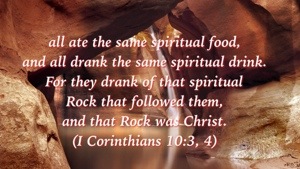
Moreover, brethren, I do not want you to be unaware that all our fathers were under the cloud, all passed through the sea, all were baptized into Moses in the cloud and in the sea, all ate the same spiritual food, and all drank the same spiritual drink. For they drank of that spiritual Rock that followed them, and that Rock was Christ. (I Corinthians 10:1-4)

Jesus himself was the Rock from which would flow waters that would give eternal life to all who drank of it. When He was on the cross of Calvary, Jesus our Rock was struck by a Roman spear, and out flowed blood and water. As He was pierced for our transgressions (Isaiah 53) eternal life was made available to all. The veil in the temple was torn from top to bottom and eternal life became available to all who would receive it.

Jesus also foretold at the great feast that the river of water would not stop there. It would be an unending stream that would flow out as the Spirit to fill and satiate those who come unto Christ.

On the last day, that great day of the feast, Jesus stood and cried out, saying, “If anyone thirsts, let him come to Me and drink. He who believes in Me, as the Scripture has said, out of his heart will flow rivers of living water.” But this He spoke concerning the Spirit, whom those believing in Him would receive; for the Holy Spirit was not yet given, because Jesus was not yet glorified. (John 7:37-39)

So if you are spiritually hungry or thirsty, come unto the Rock who was stricken for you and receive this living water!
20140321-232614.jpg

Not A Berean

Having literally spent my entire life in church, I cannot count the number of times I have heard it said that we are admonished, or even commanded, to be Bereans. But are we? Where is that found? It may seem like a minor point, but nowhere in the New Testament is there a command to be Bereans. And if we are going to claim to be guided by the Bible, then when we use Bible terms we need to use them with accuracy.

The Bereans are mentioned by Luke in the 17th chapter of Acts, and here is what is said about the visit by Paul and Silas to Berea:

Acts 17:10-12 (NET)
“The brothers sent Paul and Silas off to Berea a at once, during the night. When they arrived, they went to the Jewish synagogue. These Jews a were more open- minded than those in Thessalonica, for they eagerly received e the message, examining the scriptures carefully every day to see if these things were so. Therefore many of them believed, along with quite a few a prominent Greek women and men.”

So what is said about this relatively successful encounter was that they were open-minded, and looked into what Paul was saying to give it a fair hearing and see if this was true or not. They were intellectually honest; that’s all. In fact, while many did believe, some did not. But at least they were open-minded enough to hear him out and research things before jumping to any conclusions. If you are like that, then you can see here that such an approach can be profitable.

Thessalonica is mentioned in the preceding verses as a contrast to those in Berea. What made the Bereans more open-minded, or noble? Well let’s see from chapter 16.

Acts 17:1-9 (NET)
“After they traveled through Amphipolis and Apollonia, they came to Thessalonica, where there was a Jewish synagogue. Paul went to the Jews in the synagogue, as he customarily did, and on three Sabbath days he addressed them from the scriptures, explaining and demonstrating that the Christ had to suffer and to rise from the dead, saying, “This Jesus I am proclaiming to you is the Christ.” Some of them were persuaded and joined Paul and Silas, along with a large group of God- fearing Greeks and quite a few prominent women. But the Jews became jealous, and gathering together some worthless men from the rabble in the marketplace, they formed a mob and set the city in an uproar. They attacked Jasons house, trying to find Paul and Silas to bring them out to the assembly. When they did not find them, they dragged Jason and some of the brothers before the city officials, screaming, “These people who have stirred up trouble throughout the world have come here too, and a Jason has welcomed them as guests! They are all acting against Caesars decrees, saying there is another king named Jesus!” They caused confusion among a the crowd and the city officials who heard these things. After the city officials had received bail from Jason and the others, they released them.”

So the difference was that the Bereans didn’t form a mob, riot, and want some body to die because of the message about Jesus Christ. Want to be a Berean? Then when someone preaches something you are unsure of or unfamiliar with, research it instead of forming a riotous mob and trying to kill someone.

Well if we are not commanded to be Bereans, then should we just believe everything a preacher says to us? No, but there are other verses that talk about that. There is no need to insert a command where there isn’t one in the text, for to do so makes us among those who add to the Word. And technically, you can be a Berean and reject the correct message, like some of them did in Acts 17.

So what should we do if we hear preaching on a subject?

1 Thessalonians 5:21 (NKJV)
“Test all things; hold fast what is good.”

Not everyone is going to get it 100% right every time. That doesn’t make them a false prophet; it makes them human and fallible. So test all things, whether it is teaching, a new practice, and see how it lines up with scripture. Whatever passes the test, keep. Whatever doesn’t, toss out. And tell your fellow believers that we are commanded to test all things. Just don’t tell them we are commanded to be Bereans when no commandment is there. We must handle the Word of God accurately if we are to show ourselves to be rightly dividing the Word.

20140315-145452.jpg

Crushed For Us

This as no accident. It was not a spur of the moment decision. Jesus didn’t just use it because it just happened to be available. He chose to use the cup of wine for a deliberate purpose. Was is just because grape juice looks like blood and would be a good physical reminder for us? Maybe, but I believe it was fulfillment of specific Old Covenant typology. Let me tell you what I mean.

Wine, or the fruit of the vine, was used in the Old Testament as a symbol of the wrath of God. I quickly want to build a foundation here. Here is how God described it in Isaiah 63:1-6 (NKJV)

1 Who is this who comes from Edom,
With dyed garments from Bozrah,
This One who is glorious in His apparel,
Traveling in the greatness of His strength? —
“I who speak in righteousness, mighty to save.”
2 Why is Your apparel red,
And Your garments like one who treads in the winepress?
3 “I have trodden the winepress alone,
And from the peoples no one was with Me.
For I have trodden them in My anger,
And trampled them in My fury;
Their blood is sprinkled upon My garments,
And I have stained all My robes.
4 For the day of vengeance is in My heart,
And the year of My redeemed has come.
5 I looked, but there was no one to help,
And I wondered
That there was no one to uphold;
Therefore My own arm brought salvation for Me;
And My own fury, it sustained Me.
6 I have trodden down the peoples in My anger,
Made them drunk in My fury,
And brought down their strength to the earth.”

In Joel the wine press is once again used to demonstrate wrath and judgment.

Joel 3:13-14 (NKJV)
Put in the sickle, for the harvest is ripe.
Come, go down;
For the winepress is full,
The vats overflow—
For their wickedness is great.”
14 Multitudes, multitudes in the valley of decision!
For the day of the Lord is near in the valley of decision.

Moving ahead to the Book of Revelation, the wine press is again used to illustrate wrath and judgment.

Revelation 14:17-20 (NKJV)
17 Then another angel came out of the temple which is in heaven, he also having a sharp sickle.
18 And another angel came out from the altar, who had power over fire, and he cried with a loud cry to him who had the sharp sickle, saying, “Thrust in your sharp sickle and gather the clusters of the vine of the earth, for her grapes are fully ripe.” 19 So the angel thrust his sickle into the earth and gathered the vine of the earth, and threw it into the great winepress of the wrath of God. 20 And the winepress was trampled outside the city, and blood came out of the winepress, up to the horses’ bridles, for one thousand six hundred furlongs.

We now need to reflect on what a wine press is designed to do. Put very simply, a wine press exists to crush grapes, applying enough sustained pressure to extract the juice. Nothing else will work as well. But what does this have to do with Jesus and the Lord’s Supper? Glad you asked. Talking Jesus, the suffering servant, Isaiah recorded this in chapter 53:10

Isaiah 53:10 (ESV)
Yet it was the will of the Lord to crush him;
he has put him to grief;
when his soul makes an offering for guilt,
he shall see his offspring; he shall prolong his days;
the will of the Lord shall prosper in his hand.

Jesus, while praying in the garden, already knew that He was going to suffer the just wrath of God for our sins. He was to be a propitiation for our sins by taking the penalty that those sins deserve. The trauma of this weighed so heavily on him that tiny capillaries were bursting and his sweat was mixing with blood. This was no quiet contemplative prayer. Jesus was calling out with every fiber of His being, “Father, if there is any other way, please take this cup from me!” But there was no other way. The demands of justice had to be met or we all would be eternally lost. So Jesus says, “not my will, but thine be done” and bears our sin in his body as he goes through the wine press of the wrath of God in our place because it was His Father’s will to crush Him.
So when we partake of the juice, a product of crushing, let’s remember that because it pleased the Father to crush his Son, the demands of justice are met, and we are no longer destined for wrath, but for salvation in Christ our Lord.

1 Thessalonians 5:9 (ESV)
For God has not destined us for wrath, but to obtain salvation through our Lord Jesus Christ,

20140314-090527.jpg

Being Cross-eyed

When I was a teenager, one of my older brothers was living with us, and he had a Siamese cat. This cat, like many Siamese, was cross-eyed, and we realized he was seeing two of everything. When he would walk into the living room and glance over at the sliding glass door, he would see two Siamese cats that looked just like him staring back. These cats would mirror his every move and growl. He would eventually attack, only to be turned back by the window. It was great entertainment! The cat got a superiority complex, which I am sure was because he stared down two cats on a daily basis and was never harmed.

But that brings up a question for us to consider. Are you cross-eyed. I am not talking about seeing double all the time and attacking sliding glass doors. What I am talking about is what the writer of Hebrews expressed in

Hebrews 12:2 –
“looking unto Jesus, the author and finisher of our faith, who for the joy that was set before Him endured the cross, despising the shame, and has sat down at the right hand of the throne of God.”

Do we live a life that is focused and Jesus and His sacrifice for us? When we remember our sins, are we taking them (and leaving them) at the foot of the cross? If we are not “cross-eyed” then we will be haunted by the guilt of the past and never know peace in our lives.

and by Him to reconcile all things to Himself, by Him, whether things on earth or things in heaven, having made peace through the blood of His cross. (Colossians 1:20)

It is also impossible to rein in our foolish pride if we are not “cross-eyed”. The cross shows us what our sinful actions and attitudes deserve. Knowing that every one of us is guilty before God of capital crimes, no matter how righteous we appear relative to others, leaves no room for boasting. All we have left to boast of is the magnitude of Christ’s love for us.

But God forbid that I should boast except in the cross of our Lord Jesus Christ, by whom the world has been crucified to me, and I to the world. (Galatians 6:14)

Perhaps being “cross-eyed” doesn’t make any sense to you. After all, the cross was a cruel instrument of torture, and was used to inflict a horrific death upon any who were placed upon it. You were considered accursed if you were crucified. Even in the times before it was invented, those who were hung on a tree were considered cursed by God.

“If a man has committed a sin deserving of death, and he is put to death, and you hang him on a tree, 23 his body shall not remain overnight on the tree, but you shall surely bury him that day, so that you do not defile the land which the Lord your God is giving you as an inheritance; for he who is hanged is accursed of God.” (Leviticus 21:22)

It just doesn’t make sense to those who are outside of Christ why we would worship someone who was cursed! At first glance such a proposition looks foolish indeed. The Apostle Paul said that many would feel this way, even in the First Century.

“For the message of the cross is foolishness to those who are perishing, but to us who are being saved it is the power of God.” (1 Corinthians 1:18)

But in order to take our curse upon Himself and atone for our sins, Jesus had to die the death of a cursed man, so we could be made the righteousness of God in Him.

2 Corinthians 5:21 (NKJV)
For He made Him who knew no sin to be sin for us, that we might become the righteousness of God in Him.

What did this accomplish? Glad you asked!

1 Peter 2:24-25 (NKJV)
who Himself bore our sins in His own body on the tree, that we, having died to sins, might live for righteousness—by whose stripes you were healed. 25 For you were like sheep going astray, but have now returned to the Shepherd and Overseer of your souls.

So let us fix our eyes on Jesus and follow after Him. We must be “cross-eyed”, just like He was. As we follow Him to the cross on a daily basis, we are reconciled, renewed, and refocused. For on our daily cross, we must crucify our old nature with its sinful desires, and walk as He walked. I don’t know if you have noticed or not, but people tend to walk in the direction they are looking. So let us be “cross-eyed” and crucified as we journey to heaven. And I think that is one of the reasons for observing The Lord’s Supper and doing so often. It helps to keep us cross-eyed. It is so effective at doing so that it baffles me that some churches do not participate in this every week. We are human and constantly need reminders to keep ourselves focused on what is important. Communing with other believers around the Table of The Lord is designed by God for that very purpose. And in doing so we are reminded that we, too, need to daily take up our cross as we are crucified with Him.

Galatians 2:20 (NKJV)
I have been crucified with Christ; it is no longer I who live, but Christ lives in me; and the life which I now live in the flesh I live by faith in the Son of God, who loved me and gave Himself for me.

20140215-131406.jpg

Ever Only All

Sometimes, when I am busy with selecting songs to use for Sunday worship, it seems like the Spirit puts a song in my mind on a continuous loop and won’t let it stop. Such was the case when preparing this week. It was an old hymn that was born in adversity and distills truth down to a brief, poignant phrase. The song was written by Frances Havergal in the 19th century. Frances only lived to be 42 and was in poor health most of her brief life. Notwithstanding, she wrote some of my favorite hymns, with lyrics that go directly to the heart.

One such hymn, the one on continuous loop in my head, was titled “Take My Life And Let It Be”. In her diary, Frances said that on one evening after prayer when she was pledging her devotion to her Savior, a phrase came to her mind and would not depart — ever, only, all. She included the phrase into a poem she wrote the next day which ends with “take my self and I will be ever, only, all for Thee.” There are less poetic ways to say the same thing, and I think what she was trying trying to communicate was that as a disciple of Jesus Christ, our desire should be to live as one who is perpetually (ever), exclusively (only), and completely (all) devoted (for) to Jesus (Thee).

This is a goal worthy of our greatest focus, for He is a Savior worthy of our greatest love. This aspiration is one that will keep us focused on He who is the Author and finisher of our faith”. And this devotion, this consecration, is not an unreasonable thing to ask of His disciples. After all, this is the same God who will do “exceeding abundantly above all we ask or think”. Surely that kind of a king is worthy of perpetual exclusive and complete worship and adoration.

I would encourage you to look at the words of this hymn and make them your prayer while taking communion. He gave his all, and continues to give His all for us, his children. Can we do less than give our all to Him?

Take my life, and let it be
Consecrated, Lord, to Thee;
Take my moments and my days,
Let them flow in ceaseless praise.

Take my hands, and let them move
At the impulse of Thy love;
Take my feet, and let them be
Swift and beautiful for Thee.

Take my voice, and let me sing
Always, only, for my King;
Take my lips, and let them be
Filled with messages from Thee.

Take my silver and my gold:
Not a mite would I withhold;
Take my intellect, and use
Ev’ry pow’r as Thou shalt choose.

Take my will, and make it Thine,
It shall be no longer mine;
Take my heart, it is Thine own,
It shall be Thy royal throne.

Take my love, my Lord, I pour
At Thy feet its treasure store;
Take myself, and I will be,
Ever, only, all for Thee.

Words: Frances R. Havergal 1874.

20140208-143359.jpg

Who Was First Peter Written To?

Much of the time, textual critics will sit and debate who the authors were of various parts of the Bible. What I want to offer some thoughts on in this case is the question of who Peter was writing to in his first letter. It may not be obvious at first glance, depending on which translation you are using. Here is what I mean.

Peter, an apostle of Jesus Christ, To the pilgrims of the Dispersion in Pontus, Galatia, Cappadocia, Asia, and Bithynia, (I Peter 1:1 NKJV)
Peter, an apostle of Jesus Christ, To God’s elect, exiles scattered throughout the provinces of Pontus, Galatia, Cappadocia, Asia and Bithynia, (1 Peter 1:1 NIV)
Peter, an apostle of Jesus Christ, to the elect who are sojourners of the Dispersion in Pontus, Galatia, Cappadocia, Asia, and Bithynia, (1 Peter 1:1 ASV)
Peter, an apostle of Jesus Christ, To those who are elect exiles of the Dispersion in Pontus, Galatia, Cappadocia, Asia, and Bithynia, (1 Peter 1:1 ESV)

Do you see why there might be some confusion on the matter of who this letter is addressed to? But we need not just give it our best guess. There is evidence in the rest of the Bible to aid in our understanding.

The differences in translation are attributed to translators’ assumptions about the text. There is the school of thought that says Peter must be addressing Jewish Christians who were the remnant that had been saved through accepting their promised messiah, Jesus. Plus, Peter had agreed with Paul that he would go to the Jews, while Paul would go to the Gentiles. But this was never a hard and fast rule, as Paul still would go and start teaching in the synagogues when he entered a new city. In addition, as far as we can tell, the places this letter was to go are all churches stared by Paul on his missionary journeys. In fact, Paul wrote a letter to one of these places, Galatia, and gave clues that would indicate that the Galatians weren’t Jews at all!

Galatians 2:8
8 (for He who worked effectively in Peter for the apostleship to the circumcised also worked effectively in me toward the Gentiles),

Galatians 4:8–9
Fears for the Church
8 But then, indeed, when you did not know God, you served those which by nature are not gods. 9 But now after you have known God, or rather are known by God, how is it that you turn again to the weak and beggarly elements, to which you desire again to be in bondage?

Galatians 6:13
13 For not even those who are circumcised keep the law, but they desire to have you circumcised that they may boast in your flesh.

But, many will say, doesn’t Peter refer to this group as the “diaspora” here? That could only apply to the Jewish people. But we must remember that when the Christians were grafted into the olive tree of the Jewish nation, not only did Jewish believers gain the benefits of being Christians, but gentile believers gained the benefits of the Jewish tree into which we were joined. The Apostle Paul, in the letter to the church at Ephesus puts it this way. This is a little long, but wonderfully makes the point.

Therefore remember that at one time you Gentiles in the flesh, called “the uncircumcision” by what is called the circumcision, which is made in the flesh by hands— remember that you were at that time separated from Christ, alienated from the commonwealth of Israel and strangers to the covenants of promise, having no hope and without God in the world. But now in Christ Jesus you who once were far off have been brought near by the blood of Christ. For he himself is our peace, who has made us both one and has broken down in his flesh the dividing wall of hostility by abolishing the law of commandments expressed in ordinances, that he might create in himself one new man in place of the two, so making peace, and might reconcile us both to God in one body through the cross, thereby killing the hostility. And he came and preached peace to you who were far off and peace to those who were near. For through him we both have access in one Spirit to the Father. So then you are no longer strangers and aliens, but you are fellow citizens with the saints and members of the household of God, built on the foundation of the apostles and prophets, Christ Jesus himself being the cornerstone, in whom the whole structure, being joined together, grows into a holy temple in the Lord. In him you also are being built together into a dwelling place for God by the Spirit. (Ephesians 2:11-22 ESV)

He puts it even more succinctly in Galatians 3:

There is neither Jew nor Greek, there is neither slave nor free, there is no male and female, for you are all one in Christ Jesus. And if you are Christ’s, then you are Abraham’s offspring, heirs according to promise. (Galatians 3:28, 29 ESV)

But what of the term “diaspora”? It originally was a word used to describe the Israelites who had been scattered abroad and were no longer in Israel. But here in 1 Peter it has a double meaning. In Acts 8:1-4, Luke wrote that persecution had caused the church to be scattered abroad instead of being concentrated in Jerusalem. They had been dispersed as a new diaspora and were obeying Christ’s command to go unto all nations. So while the terms “chosen” and “royal priesthood” and “a holy nation” were originally applied to Israel, they now applied to Israel along with those of us along for the life who God had grafted in.

So is there a place in the plan of God for national/physical Israel? You bet there is. But they will be equal members of the Kingdom of God, for He has not utterly cast them off. So when you read letters like First Peter, know that it was addressed to Christians like all of us, both Jew and Gentile alike. We have been grafted in together to form one nation under God.

But you are a chosen race, a royal priesthood, a holy nation, a people for his own possession, that you may proclaim the excellencies of him who called you out of darkness into his marvelous light. Once you were not a people, but now you are God’s people; once you had not received mercy, but now you have received mercy. (1 Peter 2:9, 10 ESV)

Jews had been a chosen people, had a royal priesthood, were Holy and set apart for God as His possession. This verse must be talking about us as Gentiles now precisely because it says those he is addressing had not been God’s chosen people in the past, but now had become such. That cannot be referring to the House of Israel because the were already called those things! Fellow Gentile believer, First Peter was written for all of us!

20140115-234306.jpg

2013 in review

The WordPress.com stats helper monkeys prepared a 2013 annual report for this blog.

Here’s an excerpt:

A San Francisco cable car holds 60 people. This blog was viewed about 790 times in 2013. If it were a cable car, it would take about 13 trips to carry that many people.

Click here to see the complete report.

Holy Days and Holidays

On this beautiful Christmas morning, I wish to address the issue of holidays. There are some who feel that we are not authorized to have holidays, and by this I mean days that are holy in a religious sense. Therefore, they reason that Christians are actually sinning, or at least in error, if the celebrate such with religious meaning attached.

What we need to do, as in most cases, is to define our terms. By “holy” we mean that something or someone is “set apart for service to God”. So by naming something as a holiday, we are setting that day apart for reflection, remembrance and celebration. So what do the Scriptures say about setting days apart for religious observance? Glad you asked, because the Apostle Paul gives us a very direct answer in Romans chapter 14. I have included six verse for the sake of context.

“Now receive the one who is weak in the faith, and do not have disputes over differing opinions. One person believes in eating everything, but the weak person eats only vegetables. The one who eats everything must not despise the one who does not, and the one who abstains must not judge the one who eats everything, for God has accepted him. Who are you to pass judgment on another’s servant? Before his own master he stands or falls. And he will stand, for the Lord is able to make him stand. One person regards one day holier than other days, and another regards them all alike. Each must be fully convinced in his own mind. The one who observes the day does it for the Lord. The one who eats, eats for the Lord because he gives thanks to God, and the one who abstains from eating abstains for the Lord, and he gives thanks to God.” (Romans 14:1-6 NET)

Of particular note are verses 5 and 6 regarding holy days. According to Paul, while under divine inspiration, there is nothing wrong at all with setting aside a day as holy. Neither is there anything wrong or sinful about NOT setting a day or days aside. Let each be convinced in his or her own mind about it.

But I do have a question for consideration by those who would still say we should not have any holy days in spite of Romans 14:5-6. Many of them celebrate other days like Independence Day and Memorial Day, etc. What does it say to those who may be observing your conduct when you are willing to set aside days to celebrate national secular events, but are not willing to do the same for events in the life of our Lord? Do you celebrate your birthday and those of your family members? I realize we do not have the exact date for the birth of Christ, but do we celebrate everyone’s birthday and not the birth of our Savior? Just so ring to think about.

Again, let each be convinced in his own mind and not judge the conclusions of a brother as inferior to our own. We live unto The Lord and answer to Him for only ourselves. I, for one, will celebrate the Incarnation and the day “the Word became flesh and dwelt among us.” John 1:14. If I can celebrate American independence on the 4th of July, I can definitely celebrate the coming of the One who sets us free eternally. Let us begin the Incarnation Celebration!

20131225-091033.jpg

Does Worship Ever End?

The Word of God is replete with commands to worship God. In the Ten Commandments ( the actual Law, not the movie), a command is given to remember the Sabbath day and keep it holy. That day, from creation onward, was set aside as God’s special day which was reserved for worship. Now, under the covenant sealed with the blood of Christ upon the cross, we are in a kind of perpetual Sabbath. We no longer follow the Sabbath, which was a shadow of things to come, but follow Christ.

“So let no one judge you in food or in drink, or regarding a festival or a new moon or sabbaths, which are a shadow of things to come, but the substance is of Christ. (Colossians 2:16, 17 NKJV)”

We have ceased from our own works and and now spending every day doing His works, which is the very reason we are saved.

“There remains therefore a rest for the people of God. For he who has entered His rest has himself also ceased from his works as God did from His. (Hebrews 4:9, 10 NKJV)”

Well that is great and all, but it does bring up a question. When do we worship? Glad you asked?

“I appeal to you therefore, brothers, by the mercies of God, to present your bodies as a living sacrifice, holy and acceptable to God, which is your spiritual worship. (Romans 12:1 ESV)


So it looks like there is still a requirement for us to offer a sacrifice, but now, that sacrifice is ourselves! Good thing it’s a living sacrifice! There is no day restriction for this. Our act of worship is the offering of our lives, not a set of rituals, ceremonies, or acts of worship performed according to exacting specifications anymore. Now, everything we do is done “in the name of The Lord”, not just when we assemble, but all the time!

“And whatever you do in word or deed, do all in the name of the Lord Jesus, giving thanks to God the Father through Him. (Colossians 3:17 NKJV)”

So am I saying that there is no longer any need to assemble together? Wrong! We are told by word and example to gather together to teach and encourage one another. The earliest Christians in Acts 2 gathered every day, while later they gathered on the first day of the week. Romans 14 makes it clear that we have leeway on what day, or days, we gather. All days are alike, because all days are days of worship where we are doing everything in a way that brings glory to God. In fact, there is no scriptural authority for calling our meetings “worship services” at all. Our living sacrifice is our service of worship. Nor are we given a list of what can be designated as worship and precisely how it is to be done. “Decently and in order” is a guideline that is very general in nature in many ways.

So are we supposed to worship God? Yes. When? All the time! Do we have authority to stop worshipping? No! How do we live/worship? In love, decently, and orderly! Do we have the scriptural authority to divide our lives between worship and non-worship? No! Does the Bible contain a command, example, or inference for everything we can do in our lives 24/7? Of course not. Just keep it encouraging, loving, decent, and do go wild about it. We are free to worship in a way that is guided by the Spirit and focused on the Truth — Jesus.

20131008-174153.jpg

Faith Without Conditions

Faith. It is a fruit of the Spirit that is essential to our spiritual progress, and even our salvation. Much is said in the Scriptures about having faith enough to receive whatever we ask of The Lord. And it is correct to say that God rewards the faith of those who diligently seek Him.

But there is a deeper level of faith than the one required for receiving an affirmative answer to our requests. A question we all need to consider is this: “Do I have enough faith to get a ‘no’ from God?” Please let me illustrate what I mean.
If you are faced with a terminal illness, do you have enough trust and faith in God to continue to follow Him if you are not healed? Do you trust Him enough to die if that is His will? I submit to you that this takes more faith than receiving an instant healing.

That kind of faith was shown by the three Hebrew young men who refused to worship the golden statue of the king.

If that is the case, our God whom we serve is able to deliver us from the burning fiery furnace, and He will deliver us from your hand, O king. But if not, let it be known to you, O king, that we do not serve your gods, nor will we worship the gold image which you have set up.” (Daniel 3:17, 18 NKJV)

Did you catch what they said? They believed that God could protect them, but were determined to follow His commandments even if their deliverance did not come. That is the kind of faith God is looking for — unconditional faith! I think it was there “no matter what” attitude that helped them to be delivered from the fiery furnace without even a hint of smoke on them. You see, faith is not belief without evidence; it is obedience without reservation.

In the Gospels, Jesus showed that same kind of faith in the Garden of Gethsemane.

He went a little farther and fell on His face, and prayed, saying, “O My Father, if it is possible, let this cup pass from Me; nevertheless, not as I will, but as You will. ” (Matthew 26:39 NKJV)

Jesus’ depth of faith and trust was displayed by His willingness to receive form The Father whatever the divine will entailed. It involved subordinating His own will to that of the Father. It begs the question about our own faith. Am I willing to not shrink back in my faith if it means the will of God leads through the valley of the shadow of death? When it all comes down to it, will we be able to say what Job said? “Though He slay me, yet will I trust Him (Job 13:15a).”

Too often today, the lost are told that they need to come to Christ because of all the things He will do to make life better for them. It’s a “me” centered message that is both harmful and unbiblical. Television preachers talk incessantly about how healing or deliverance hinges on how much faith they have. But salvation is not about having “our best life now” or being a success in business. It is about complete and utter surrender to the will of God, no matter where that leads us. That is why we need to be able to put aside what we desire and accept what He desires without reservation.

20130330-004916.jpg