Our Passover Lamb

Our Passover Lamb

Exodus 12:3-9
Egypt was a ruined nation, but still Pharaoh would not free the Israelites. God promised to send one final plague. The Destroyer of God would kill every first-born son in the land. God established a special meal that was to be eaten by the Israelites from then on to remember how they were rescued from Egyptian bondage. But this feast means something for us even today. It has meaning for us because it foreshadows:
a. Our Passover Lamb, Jesus Christ (I Cor. 5:7). 7 Clean out the old leaven so that you may be a new lump, just as you are in fact unleavened. For Christ our Passover also has been sacrificed. NASB

b. Our deliverance from the slavery of sin (Rom. 6:17-18). Freed from sin and are now slaves to righteousness.

c. Our special meal (The Lord’s supper) that helps us remember the Blood that was shed for us (Mt. 26:28). 28 for this is My blood of the covenant, which is poured out for many for forgiveness of sins.
Let us notice some interesting parallels between the Passover lamb of Israel and our Passover Lamb, Jesus Christ.
**tTurn to the text, Exodus 12:3-9**
A beloved lamb (verses 3 and 6).
They were to select a lamb on the tenth day of the first month and keep it until the 14th day. It became the custom of each Israelite family to take the lamb into their home, feed it, cuddle it, love it, and treat it as one of the family. Then on the fourteenth day, its little throat was slit and the blood of that precious little lamb was pour into a basin.

Some here were raised on livestock farms. Children on farms were not allowed to get attached or name livestock. This was to prevent the feeling of eating a family pet. An Israelite family, however, loved, petted, even named their lamb. Then watch it die and ate it. This was all a part of God’s plan. Why?

God must have had Jesus in mind. John 3:16 16 “For God so loved the world, that He gave His only begotten Son, that whoever believes in Him shall not perish, but have eternal life.This was not a stranger God offered but a Son; not just a Son but His only Son; not just His only Son but His beloved Son; not just His only beloved Son but a beloved Son in whom He was pleased! This Son was real! He had a name! He is our Savior so we call Him Jesus, He is our ruler so we call Him Lord, and He is our God so we call Him Immanuel, and He is God’s anointed one so we call Him Christ!

Through this Passover lamb, God began to show us the ugliness of sin, the price of deliverance; something we love had to die! Imagine a pet raised to be put to death, now imagine your child coming into this world for the purpose of being put to death.

A shared lamb (4).

This lamb was to be shared, no leftovers. It was a time of fellowship and sharing, the families all under one roof (Similar to our Thanksgiving meal). This foreshadowed our partaking of the Lord’s Supper. We too, are one family under one roof, partaking of one bread, one fruit of the vine. Like Israel we celebrate our deliverance. Imagine the emotions of that occasion (sadness, joy). Shouldn’t we share the same type of emotions when we partake of the feast?

The best lamb (5).

The Passover lamb was to be in the prime of life (one year old), perfect in every way, no spots or blemishes.I Pet. 1:18-19 18 knowing that you were not redeemed with perishable things like silver or gold from your futile way of life inherited from your forefathers, 19 but with precious blood, as of a lamb unblemished and spotless, the blood of Christ.

The only perfect human who ever walked on this sin-blemished earth was crucified at the age of 33, in the prime of His life. Why so young? He could have perhaps accomplished more if allowed to live longer, but it had to be a perfect sacrifice.

A bleeding lamb (6-7).

Blood is important in our lives. In this first Passover blood was essential for the sparing of life.Blood was smeared on the doorposts. Blood from this lamb was salvation. We too, face death; spiritual death and we need blood to save us.I Pet. 1:18-19

Blood on the door symbolic of the cross.

A whole lamb (8-9).

They were to roast the lamb. Could not boil, that would hide the lamb in a pot. Head, legs and insides were to be kept intact. Keep in mind when you roast something you place it on a spit, a wooden stick for all to see. When we cook an animal we have the butcher prepare it in such a way until it no longer resembles the animal we are eating. (Some even dislike eating whole fish.)

But the Passover lamb was to be prepared in such a way that people never forgot what they were eating. It was their pet, family member; it had a name, roasting there in front of them. Not just meat on a spit, but their beloved lamb suspended on a wooden stick.
Jesus was placed on a wooden stick to die for us, for the entire world to see. Like the lamb He was left whole, not a bone broken. Can you see Him there suspended between heaven and earth, between two thieves, dying the death of a criminal, dying in your place and in my place (Jn. 1:29)?
What would have happened if the Passover lamb was not slain, blood not applied?
20120628-013615.jpg

Return to Simplicity

Simplicity In Christ
There is something to be said for keeping things simple. It seems that with everything that we add, with every layer of complexity that feels like a good thing at the time, we give ourselves more opportunity for distraction. In the end, we can even end up focused on things other than what we started with. As with driving your car or running a race, we tend run to go in the direction we are looking. And as they said in West Texas, “if you don’t get off the road you’re on, you’re liable to end up where you’re headed!”
The same is true when it comes to the church and the things we do as the Body of Christ. Over the past two thousand years, many layers of “good ideas” and new programs have been added on by well intentioned people. As a result, the focus has shifted to things other than Christ. We have come to see those who attend as the audience, while those up front on the platform perform. Yes, the congregants sing along with the songs from the band, but most of what happens is designed to minister to us and bring in more people.
Many would be shocked to discover that Jesus didn’t say a thing about marketing the church. Or for that matter, about programs designed to provide what other churches don’t or can’t, in an effort to win over people like they are religious consumers and the church is a service provider in the marketplace.
The Apostle Paul put it this way:
“But I am afraid that, as the serpent deceived Eve by his craftiness, your minds will be led astray from the simplicity and purity of devotion to Christ.” (2 Corinthians 11:3 NASB)
A call has gone out, and continues to go out. It says to strip away the programs, the marketing and everything else that has been added on, and return to simplicity of devotion to Christ! Let’s gather as a spiritual body and worship with only one person in the audience — Jesus Christ. Let’s focus on love and spurring one another on to good works. Let’s get rid of the marketing plans and draw people to Christ by lifting Him up instead of what we have to offer spiritual consumers!
It may be uncomfortable at first. After all, we have gotten used to some things that we like. But if we can get back to the basics, to the simplicity of devotion, we will be able to keep the main thing as the main thing. What does that look like?
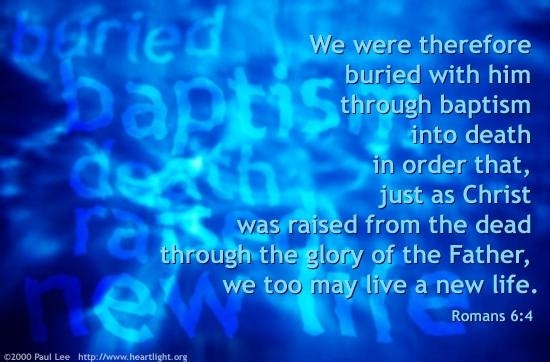
Well, here are some examples of things that are add-ons. Let’s dump D.L. Moody’s invention called the “sinners prayer” and go back to having converts accept Christ and ask for His pardon the way they did in the First Century. It was and is called baptism. The concept of an unbaptized believer is foreign to the New Testament. Modern churches have someone say a prayer, wait awhile, and make their faith public by water baptism. But in the New Testament, baptism was the sinners prayer. It is an “appeal to God for a good conscience (1 Peter 3:21) and the way sinners “called upon the name of the Lord.” Acts 22:16. While some will point to Romans 10:9-10, those verses have a context. Even the NIV Study Bible says they contain the early baptismal formula, required before one could be baptized like Paul had said earlier in Romans 6:3-11.
There were also no choirs or instruments for the first 700 years of the church, in large part because they wanted to avoid being like the world. Singing without a choir or instruments means we all must participate sing to one another, and worship the One who is our sole audience. It is not that instruments and choir are evil. I have been in and used both. But it is a distraction, and if we aspire to be like our original brethren, they just don’t fit the paradigm of simple Christianity.
Where can this simplicity be found? Well I can tell you where some are attempting to do it. It was the place I grew up in, left, and have come home to. I would encourage you to look for simplicity at one of the churches of Christ. I am part of a congregation that is striving to keep it simple, yet keep it in love. If you are in the Fox Cities area in Wisconsin, come on down to the Appleton church of Christ. We don’t believe in denominations because Christ is not divided, and denominations represent institutionalized division. We are just Christians worshipping and serving in simplicity.

20120628-014643.jpg

Four Fs

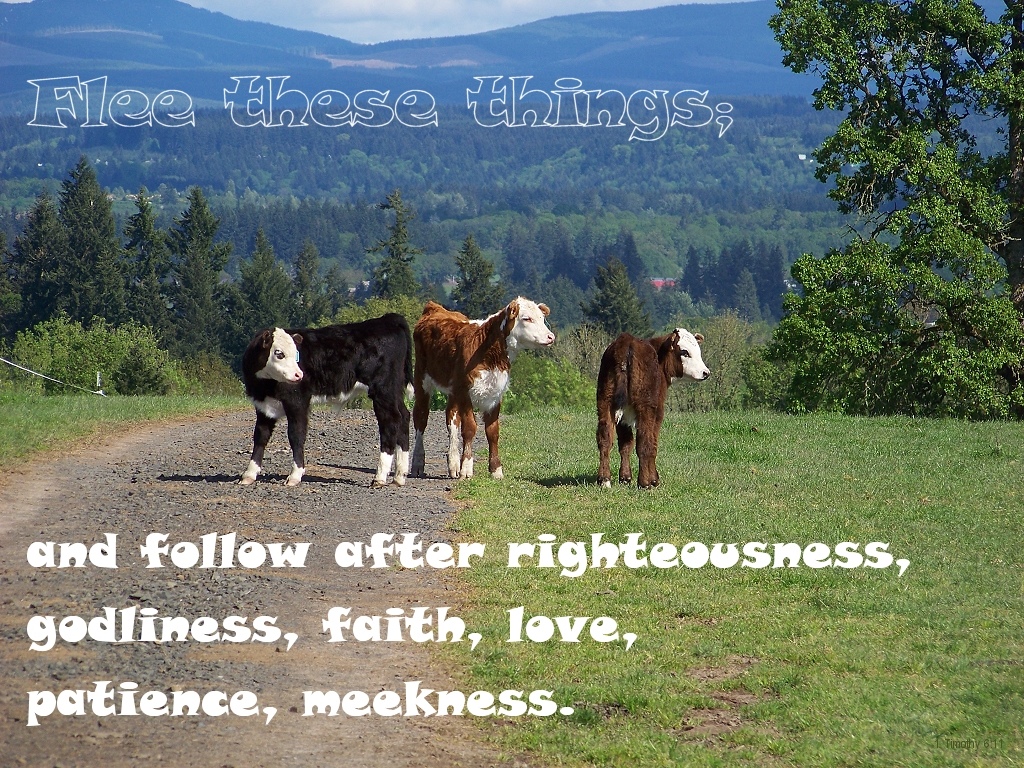
But thou, O man of God, flee these things; and follow after righteousness, godliness, faith, love, patience, meekness. Fight the good fight of the faith, lay hold on the life eternal, whereunto thou wast called, and didst confess the good confession in the sight of many witnesses. (1 Timothy 6:11, 12 ASV)
To strive toward the prize, the high calling of God in Christ Jesus, there are four things we need to do that are mentioned in these two verses.
1. Flee “flee these things”
A. I am not speaking of cowardice here. Sometimes, as in the example of covetousness in the previous verses, the most courageous thing to do is flee. Like Joseph with Potiphar’s wife, there are times when our best resistance is to flee. That’s why in 1 Corinthians 10:13 Paul said the Lord will, when we are tempted, provide a way of escape.
2. Follow “follow after righteousness, godliness, faith, love, patience, meekness”
A. it is not enough to run away from sin. We have to run toward something else. We are not running in a panic. We need to deliberately run to righteousness and the other fruit of the Spirit mentioned here. Remember that this step is only possible if we first flee the other things.
3. Fight “Fight the good fight of the faith”
A. What kind of fight is a “good fight”? One we win! And for that to happen, it needs to be a fight of faith. We don’t battle against flesh and blood (Eph 6) so the best place to fight is on our knees, wielding the sword of the Spirit, the Word of God.
4. Finish. “lay hold on the life eternal”
A. This is no passive finish. This is a deliberate laying hold of eternal life. It’s a white knuckled grip where we are intentional about laying hold of eternal life. Only then will we fulfill our calling in God. None of our efforts will matter if we do not finish the course!
The key to victory in this life is to flee, follow, fight, and finish. but none of this will happen unless you first start the journey? Do you believe Jesus Christ was exactly who he claimed to be? That he died for your sins and rose again? Will you repent of those sins and follow after Christ? And will you “confess the good confession in the sight of many witnesses” and then be baptized into Christ? Then begin today!

20120628-014122.jpg